


French Service For 24 Persons (Service A La Francaise Pour 24 Couverts)
Description
This section is from the book "The Epicurean", by Charles Ranhofer. Also available from Amazon: The Epicurean, a Complete Treatise of Analytical and Practical Studies on the Culinary Art.
French Service For 24 Persons (Service A La Francaise Pour 24 Couverts)
The first service is composed of hors-d'oeuvre (side dishes), two soups, two removes, four hot entrees, or two cold and two hot entrees.
Remove the cold hors-d'oeuvre; serve the punch or sherbet.
The second service is composed of two roasts to take the place of the removes; four entremets, two being of vegetables, one hot sweet entremets and one cold; these to replace the entrees; two entremets cakes to take the place of the cold entrees.
Prepare the table for the dessert.
The third service, or dessert, is composed of two shelved stands filled with bonbons, victorias, bonbon boxes, cossacks, two low stands or drums containing small fancy cakes, two basketfuls of fresh fruits, two assorted compotes, one orange jelly, one Bar-le-Due jelly and two cheeses; two fancy pieces of nougat or candied sugar to replace the entremets cakes.
The wines should be selected and served as indicated in another chapter, according to the taste and desire of the host.
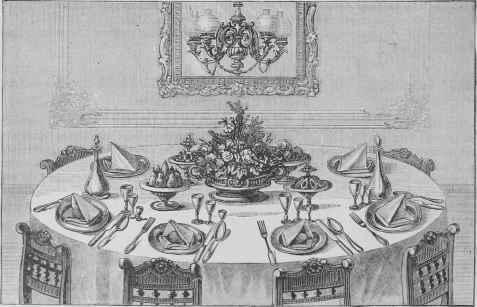
French Service, Dinner For 24 Persons - To Set The Table (Service A La Francaise, Diner De 24 Couverts - Le Couvert)
The table must be sixteen to eighteen feet long and six to seven feet wide, with rounded corners, covered with a table-cloth and having exactly in the center a high stand or epergne, or piece of silverware or bronze, filled with flowers. Continue the middle line with candelabras or lamps; leave a place for the chafing dishes and between these arrange the cold hors-d'oeuvre.' Set the plates, the glasses to form a semicircle in front; the spoons and knives on the right and the forks on the left.
Commence serving the most honored guest on each right side, and begin each separate service at the person served the last.
All the dishe intenhed for the table should be dressed tastefully and the edges decorated with open-worked noodle borders; the meats laid symmetrically, the borders to be neither too high nor too much spread so that the dish covers can fit on easily; light bread borders can also be used.
Decorate the meats with trimmed hatelets just before placing them on the table.
Necessary Material For 24 Persons (Materiel Necessaire Pour 24 Couverts)
Let the china, glassware, silver, cutlery and linen be as much alike as possible, have the glasses all plain or cut of the same pattern and shape; the china either all white, colored or gilt; the linen plain or damasked with large or small designs.
The plates must be changed at each service as well as the knives and forks, they must be washed immediately and used again for the following services, otherwise there will be as many knives and forks needed as plates, consequently far more material.
84 soup plates.
24 side-dish plates.
72 dinner plates.
48 dessert plates.
24 soupspoons.
24 coffee after-dinner cups.
24 dessert knives and forks.
72 large forks.
72 steel knives.
24 silver or gilt knives.
24 side-dish knives and forks.
24 coffeespoons
Small salt cellars and pepper casters, one for each person.
12 radish dishes for 24 persons.
A glass or silver knife rester for each person.
8 silver toothpick holders.
24 wine decanters and water bottles.
2 soup tureens.
2 chafing dishes and covers for removes.
4 chafing dishes and covers for entrees.
2 chafing dishes and covers for roasts.
24 water glasses.
24 Chablis glasses.
24 Bordeaux glasses.
24 Frontignan glasses.
24 line Bordeaux glasses.
2 shelved stands.
2 silver baskets for fruits.
2 drums for fancy cakes.
2 dishes for jellies.
2 dishes for cheese.
4 compote stands.
4 dishes and covers for vegetables.
2 dishes for cold entrees.
24 sherry glasses.
24 Burgundy glasses.
24 liquor glasses.
24 Champagne flutes or goblets.
24 punch or sherbet glasses.
Fine Baccarat glass is the handsomest; keep in reserve glasses of all kinds in case of an accident.
The oil and vinegar caster, as well as the mustard pot, are to be passed around according to necessity.
Continue to:


My Books

