


Recipes For Ices (Glaces)
Description
This section is from the book "The Epicurean", by Charles Ranhofer. Also available from Amazon: The Epicurean, a Complete Treatise of Analytical and Practical Studies on the Culinary Art.
Recipes For Ices (Glaces)
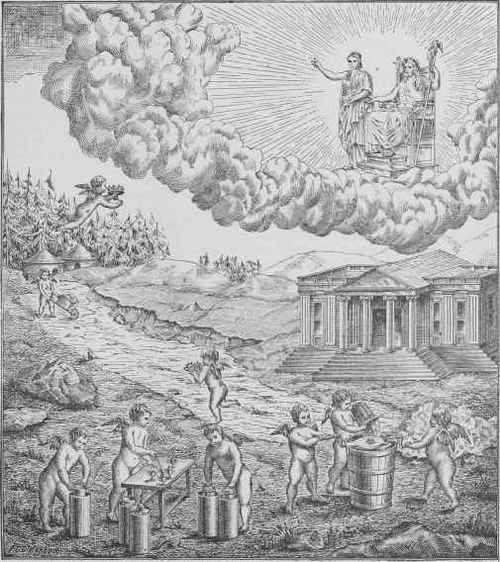
(3424). Ices (Glaces)
Preliminary Remarks
We call ice (in general) a solid body, formed naturally or artificially from a fluid substance, such as water, oil, etc.. frozen to a certain degree. It can also be said to be a fluid compressed by the lowering of the temperature to zero. Therefore, ice is nothing but crystallized water, lighter than liquid water, as it floats on its surface. In alimentary language ices are compounded creams or liquors made to freeze. Many books have been written on the subject of ices, and many serious researches have been made, hence it is not our intention to enter into the various details, as they can more easily be learned by consulting these divers works. Still we have considered it our duty to recall in a few words the history of the manufacture of these perfect and delicious refreshments. By going back to the most ancient times we find, especially in southern countries, that they had learned of the benefits to be derived from cool drinks, so we suppose the use of ice was known to the Greeks and Romans, and we read that Hippocrates, the father of medicine, recognized the impropriety of its use, as well as that of snow.
The Orientals partook of iced drinks, also the Persians and the Spaniards had vases called alearazas (in French Gourgourlelles), an earthen vessel without handles, to contain and keep the water cold. Therefore, the progress made in the seventeenth century and productive of such vast improvement was but the realization of an idea discovered centuries before; this is plain, for in those days as in these, they understood the necessity of having within their reach refreshing drinks suitable for the hot seasons of the year. Doubtless they were far from possessing the resources we have at our disposal to-day as regards material, for it was only at the end of the sixteenth century that the use of ice-boxes was first invented; nevertheless, our forefathers learned how to utilize the natural means at their command. With the assistance of porous vases exposed to a brisk current of air, also to all the sunlight possible, and by wrapping them in wet cloths, a sufficient degree of cold was obtained to have the value of such a drink appreciated, while suffering from the heat of the climate. Later, the people were not satisfied by procuring a temporary cool liquid, but devised some other plan by which they could retain the cold they had thus obtained.
The only way to accomplish this was to transform the liquid drinks into a solid mass - in one word freeze them. The idea was rational, but chemistry, a science so thoroughly restricted in those days, and only understood by a few privileged persons, was found to be of very little assistance. However, in one of Bacon's works (a celebrated physician and chemist of the sixteenth century) , we find a sentence which reads as follows: "It is evident that salt when mixed with ice for artificial congealments increases the action of the cold." At the end of the sixteenth century, and at the beginning of the seventeenth century, all the physicians of those days devoted themselves to experimenting, and the result of their researches was as follows: "Ice and salt are the most active principles for congealing, observing at the same time that ammoniacal salt is the most effective, and will produce the quickest cooling result." Henceforth, the wonderful progress for making ices was rapid, and these wise men thought they had at last reached a degree of perfection. They froze liquors in tin and leaden boxes, by surrounding them with a powerful refrigerating mixture.
These ices, called rare ices and served only in sumptuous repasts, were still very imperfect, being nothing else than blocks of solid ice, reminding one of the taste of the liquor used in their fabrication, but being so remarkably hard that the pleasure of partaking of them was overbalanced by the great difficulty in eating them. They therefore endeavored to obtain a result more satisfactory to epicures. Reamur was the first person, in the year 1734, to refer to this defect, and try to ameliorate its condition. It was observed that if any liquor or fruit juice and sugar be added to water in certain proportions and that this mixture be submitted to a sufficient degree of cold, the water would be the first to congeal, while the sugars and syrups were the last. This defect had to be overcome, therefore they found that by cooking a certain amount of sugar in water they produced a syrup which they could afterward weigh. To this syrup they could mix the juices of different fruits and freeze the preparation without any fear of the defective results they sought to obviate. This was taking a great stride toward a final success, and thereafter experience alone sufficed to teach these practitioners how to acquire the best results.
Instead of leaving the mixture to refrigerate alone in order to congeal the compositions, they endeavored to find how to increase the action of the cold by giving a rotary motion, more or less rapid, to the receiver in which the operation takes place. This is why they began to employ round, elongated vessels, so much easier to manage, and to which they gave the name of sorbotieres, to-day called sorbetieres or freezers. The round freezer is evidently the best for working the ices, for not only does its shape facilitate the rotary movement employed, but this movement also connects with the liquid, and while keeping it continually well-mixed, it also keeps the interior sides of the freezer covered with all the particles of water, syrup or sugar, of which it is composed. These simple methods having been discovered it only remained to find the means of improving on them. It is not our intention to follow step by step all the contrivances invented for the making of ices. The most important fact was discovered that by careful manipulation a composition could be obtained not only agreeable to the taste, but easier to swallow and to relish.
However, we do not intend concluding our preliminary remarks without giving some general advice on the manner of cooking sugar, on the precautions necessary to the manufacture of the frozen preparation, and also on the way to mold and unmold ice cream figures.
Continue to:


My Books

