


Recipes For Large Confectionery Pieces (Grandes Pieces De Confiserie)
Description
This section is from the book "The Epicurean", by Charles Ranhofer. Also available from Amazon: The Epicurean, a Complete Treatise of Analytical and Practical Studies on the Culinary Art.
Recipes For Large Confectionery Pieces (Grandes Pieces De Confiserie)
(3635). Cornucopia, Horn Of Plenty (Corne D'Abondance)
This cornucopia is molded in a mold the shape of Fig. 751. It is made of pulled sugar (No. 3618), remelted and rolled out with a roller - this must be done very quickly - or else it can be made of white nougat (No. 3622) decorated with royal icing (No. 101 ) or of gum paste (No. 3624). Fasten it on the opening side on a nougat surtout, and support the body of the cornucopia by fastening two rests molded in gum paste in a two-piece mold, and place a wire in the center of each: attach the two pieces together and let get very dry. The cornucopia is surmounted by a gum paste Cupid; the inside border of the opening of the dish is made of pulled sugar and is composed of rings, with smaller ones of a darker color placed inside of one another; bend them lightly to spread open on sheets of tin, then fasten them to the inside border of the dish with cooked sugar; between each one arrange a lozenge of glazed angelica. The opening of the cornucopia is filled with candied fruits, or else others made of chestnut or almond paste (No. 125;, and glazed with sugar cooked to "crack" (No. 171). This piece may be made of white gum paste (No. 3624) and decorated with gold reliefs, or it may be utilized by replacing the fruits with fruits imitated in cream or water ices.
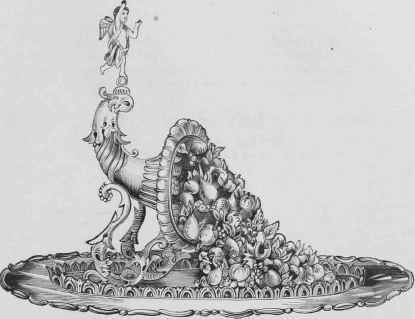
Fig. 751.
(3636). The Dosser A La Denivelle (La Hotte A La Denivelle)
Roll out some nougat (No. 3621) to a quarter of an inch in thickness, and from it cut with either a tin or oiled cardboard pattern a piece fifteen inches long by six on one end and four on the other in width, rounding the six-inch end which is for the upper part of the dosser; also cut another piece of a semicircular shape four inches in diameter by two and a half inches in radius. Prepare eleven wires, two eight inches long, two of seven and three-quarters, two of seven and a half, two of seven and a quarter, two of seven and one of six and three-quarters inches; coat them all with colored sugar. Fasten the semi-circular bottom on the large piece at its narrowest end, near the edge; on this bottom arrange the wires, beginning with the eight-inch ones on each side beside the back of the dosser, and continuing with the others according to their various lengths, at the same time spreading them open toward the top. Coat with green sugar two more wires each nine inches long, and leave to cool.
Cut out a round bottom twelve inches in diameter, then fasten the dosser on the center of it, pressing it against the two long wires to be used for a support; decorate the whole profusely with leaves and flowers made of satinated pulled sugar (No. 3618), and. fill the dosser with mushrooms or strawberries made of almond paste (No. 125), also some angelica coated with sugar cooked to " crack " (No. 171). The dosser may be filled with small ices imitating flowers.

Fig. 752.
(3640). Candying, Cold And Hot (Candi A Froid Et A Chaud)
Cold
This manner of candying is specially adapted for bonbons. Put some lump sugar in a copper pan, pour over sufficient water to dissolve it, and as soon as this takes place set it on the fire to cook to thirty-five degrees; when the sugar has attained this degree take the pan from the fire and stand it in a basin or any other receptacle filled with cold water; cover the sugar with a round of paper, and leave stand till cold. Now pour it into the candy pans containing the pieces to be candied; put in a dry place in a moderate temperature and leave for twelve to eighteen hours: drain off the syrup and place the candied pieces on a grate to dry.
Hot
This manner of candying is used specially for candying preserved fruits. Cook some syrup to thirty-six degrees; leave rest for one instant, then pour it into the candy pans, having the fruits already arranged therein; place the pan in a heater, having it moderately hot, and remove only after six or seven hours, or when the fruits are all coated.
(3641). How To Cast In Starch (Pour Couler A L'Amidon)
To cast in starch wooden boxes are required twenty inches long, fourteen inches wide and three inches deep. Fill these boxes with very dry starch to a quarter of an inch from the top; stir about with a small whip to have it light, then smooth neatly with a ruler; now imprint into it with small plaster molds fastened on to a second ruler at some distance apart, burying them in the starch until the ruler touches the edges of the box. Should these small molds have a channeled surface or deeply imprinted designs, then before lifting them out of the starch rap the ruler lightly on to]) to have any of the starch that may adhere fall away. Care must be taken to sift the starch from time to time to rid it of any lumps or grains of sugar that may have formed therein. To cast the sugar use a funnel in the center of which is a rod terminating in a ball that fits the outlet of the funnel accurately. This rod is moved up and down by means of a horizontal lever and a spring which are fastened to the handle of the funnel.

Fig. 759.
Continue to:


My Books

