


The Fireless Cooker
Description
This section is from the book "The Fireless Cooker", by Caroline B. Lovewell, Frances D. Whittemore, Hannah W. Lyon. Also available from Amazon: The Fireless Cooker.
The Fireless Cooker
A fireless cooker consists of a kettle or other vessel that can be heated, enclosed in a box or other outer shape, with enough insulating material between them to prevent the heat in the kettle from escaping. Food brought to a boiling point over a fire and enclosed in such a way must continue to cook. It is an easy matter to make such a contrivance. After choosing a good kettle with a tight cover, select a box large enough to allow six or eight inches of insulating material. This must be so adjusted as to form a compartment for the kettle in the middle of the box. Make a firm cylindrical shape to fit loosely around the kettle, and fasten a circular bottom to it. For the packing use wool, cotton, ground cork, crumpled newspaper, or some other nonconductor of heat. Fill the bottom of the box to a depth of three inches, and place the metal or pasteboard cylinder upon it. Pack all around the cylinder up even with the top. Press the packing down very hard. The top of the insulating material may be neatly covered with cloth or metal or with a board having a round hole in it. A thick cushion is now needed to insulate the space above the kettle and the lid of the box should be held closely down. This simple compartment with its single kettle will prove that a fireless cooker is a most useful article in any home. Another compartment with another kettle in it is easily added; then two kettles in each compartment, one above the other.
The ease with which a fireless cooker can be constructed, the small outlay necessary to insure a perfectly efficient and reliable cooker, and the great comfort, convenience, and saving the cooker has been to us, the past two years, have led us to place this wonderful and practical plan of cooking before you. The directions and explanations are the outgrowth of tests and experiments, and this volume is put forth in the hope of helping others. We hope that the conservative or skeptical may be induced to make a cooker, even if ever so simple, and by experimenting realize the good of which it is capable.
The primary object is to save the time and strength of the cook. Women may be so busy in the doing, in the laborious service of the Biblical Martha, that they find no time to accept the invitation, "Come ye apart and rest awhile," whereby to gain steadiness of purpose and power to meet the exigencies which must arise in all daily life.
The fireless cooker saves fuel also, and utilizes many of the cheapest and most nutritious foods. It wins to our glad service the tough but nutritious meats and all kinds of dried beans, peas, lentils, corn, and fruits which we seldom use because of the time and fuel required to make them tender and palatable. The result is that the housewife who is so disposed, may keep a much larger per cent of the family income out of the kitchen and yet "set a good table" of the most deliciously cooked food.
We have adapted our old tried and favorite recipes to the cooker; and many new combinations result from the use of the articles requiring long cooking. The recipes herein given may sup-ply a family with nutritious and wholesome food, of pleasing variety, and tempting alike to the eye and the palate. Supplement fresh fruits and salad greens, delicate crackers, cheeses, nuts, salad oils, sauces, and candies, according to your taste and pleasure, and the most fastidious are satisfied.
The manager of a cooking box will be willing to study it and its possibilities somewhat as she does a new sewing machine and its attachments. Use a little wise forethought, some careful attention to the menu, and, with recipes skilfully concocted, the result will be a delight. The cooker may not do all the work any more than the sewing machine does, but it certainly deserves a large place in our culinary department.
Busy women, mothers, teachers, students, and all those who have work outside as well as in the home, may prepare wholesome, nutritious, economical, and attractive dishes, with very little time spent over the kitchen fire.
Many dishes, like the meat and potato stew, vegetable soups, etc., will serve for a complete dinner, with the addition of a dessert of fresh fruits or of a dainty pudding. All of these can be prepared in the cooker early in the morning and be ready for the midday meal or for the dinner at night.
By this method cookery becomes truly laboratory work, and it is probable that fireless cookers of one kind or another will soon be found in nearly every home; on the ranch of the cattle man, in the tenement of the wage-earner, and in the home of the rich. They are already used in Europe. In Sweden they are built into the house adjacent to the kitchen chimney. Hotels in this country are adopting them. The United States army is proving their value at the government posts, and also in the field. Their principal value in the army is as a time saver. Breakfast is prepared during the evening thus avoiding the necessity of the cook's rising before daylight. On the march, after breakfast is served, dinner is prepared, placed in the cookers and on the wagons, and served immediately on arrival in camp, instead of several hours later as has been the custom. The big packing companies appreciate this method and use immense boiling cookers to boil their hams for the market, and claim that they save thereby twenty per cent of shrinkage.
The idea of fireless cooking is still in the process of development, and the most finished cooker of to-day will, no doubt, seem to the future housekeeper as crude and primitive as does the Indian bake oven to us. The cooker need not be of home construction. There are several manufactured cookers on the market. Some of them are of unquestioned merit ; and we should be glad, if you wish, to put you in communication with the manufacturers of those which seem to us the most desirable. But we are pledged to no cooker company. Our plea is for the idea, the method, which is so full of promise to the housekeeper.
It will save countless steps and much anxiety. It is capable of doing a large part of your cooking while you sleep. And we would like to make the plea so strong that every housekeeper, every mother who gleans hints of helpfulness from this little book, may be induced to adopt the method in her home. What we plead for is a clear recognition of the principle that viands heated to a cooking temperature will continue to cook if surrounded by nonconducting material. Our refrigerators keep the heat from going in, while our cookers keep the heat from going out.
A few blank pages are introduced so that each housewife may adapt and insert her own favorite rules.
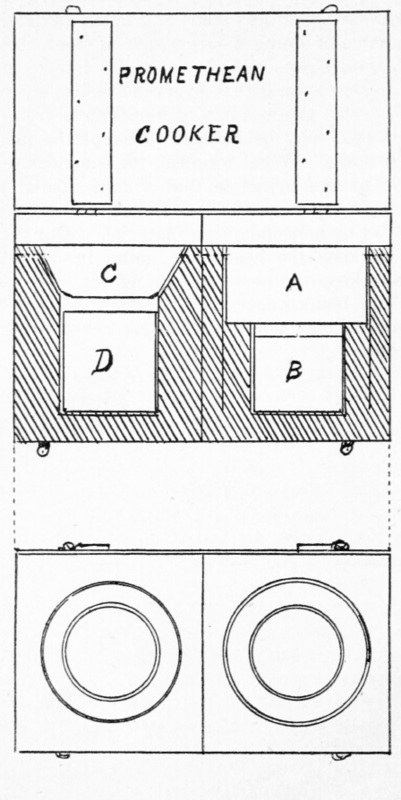
The Promethean Cooker.
During the two years and more in which we have experimented with the Fireless Cooker we have tried many models and devices. We have cooked in boxes of various sizes and shapes, in trunks, in a tin bread box, a wooden bucket, and in a barrel; and we have not slighted the pantry drawer nor forgotten the ice box. In all these experiments we have had a good degree of success and the food has really cooked. While we confess that we have a choice as to material, size, and proportion, we have reached the conclusion that any receptacle that can be tightly closed, and in which packing can be placed, may be made to serve as a cooker.
These tests have clearly demonstrated the principle upon which the fireless cooker is based ; that of the conservation of heat. When food is heated to the boiling point and kept at that temperature or a little below for a certain length of time by placing it under conditions where the heat cannot escape, the food is bound to cook. It could not do otherwise.
There is a great variety of plans and models with which we are familiar. Many have decided merit and accomplish the object for which they were constructed, but we have found that the cooker illustrated on the opposite page, because of its compact form, its large capacity, and the varied sizes of the utensils used, makes a most desirable and complete cooker for the use of the average family.
We have thought that it might be helpful to describe this cooker and its construction in detail so that you may if you choose, with but little time spent in planning and fitting, make a similar one for your own use.
First select your box and packing material. The latter may be any one of several substances; wool, cotton, excelsior, crushed paper, ground cork, or asbestos wool or fiber. All of these materials have been used with most excellent results. We do not recommend hay which was used in the original cooker, the "Norwegian Hay Box," but any good nonconductor of heat which is available will make good packing.
You may find in your store-room a quantity of cotton which has seen honorable service in some other capacity and has been discarded. This, if thoroughly washed, sterilized, and dried, will make good packing.
The cooker illustrated we packed with three different kinds of material to test their efficiency. One compartment is packed with wool, a fleece having been thoroughly washed and dried. The second compartment is packed with ground cork with sufficient cotton above to hold it down solidly and keep it in place. So far as we can judge there is no difference in the effectiveness of the different materials here used. The ground cork is used for packing the foreign grapes that come to our markets and may be obtained from any grocer. If paper is used, it should be torn into small pieces, wrinkled and crushed, and packed down solidly. This is much liked by some who have experimented extensively.
Now for the box. Procure a box the inside measurements of which are twenty-eight inches in length, height without the cover seventeen inches, and width fifteen inches. This is a size that may be found among almost any collection of packing boxes and may be had for a trifle. Select one that is smooth and free from knots and cracks. If there are heavy battens at the corners on the outside as is often the case in this class of boxes, take them off and put them inside the box as corner stays. The box will then present a more attractive appearance. Put a thin board partition through the center, dividing the box into two equal compartments. About two and one-half inches from the top of the inside of the box fasten a narrow strip of wood on each of the four sides of the two compartments for the inside covering to rest upon. Now have a good fitting cover made with cleats or stays across, so that it will not warp. This may be made in two sections if desired. Fasten on the lid with two good strap hinges. By the addition of four ball bearing casters and two fastenings for the cover, which are window locks of a pattern that is easily obtained, the box is ready for packing.
To pack the box get some fine grained strong pasteboard like that in the suit cases used by the drygoods merchants for delivering their goods. This is especially good for the purpose as it will not break easily and keeps its place well. For compartment A-B make from this board two cylinders leaving the turned edges at the top to strengthen them. For the large cylinder cut a circular piece of the board twelve inches in diameter; around this sew a strip of the same twelve inches wide, leaving a generous margin to overlap as you sew the sides together with a stout needle and thread.
The second cylinder made in the same manner should be nine inches in diameter and six and one-half inches in depth. Cover these cylinders on the inside with a light padding of some sort sewed on lightly.
Now put into the compartment A-B two and one-half inches of packing material pressing it down firmly and evenly. Place the large cylinder in the center, hold it firmly in place, and fill the space around it until it reaches the top of the cylinder. Press and pack it down as hard as possible, for upon the manner of packing the cooker depends very largely the success of the cooking. If ground cork is used, put over it some cotton or wool to keep it well in place. Now place the small cylinder in the center of the bottom of the large one and pack around that in the same manner, adding the cotton at the top as before.
For compartment C-D make the cylinder for the lower portion nine and three-fourths inches in diameter and eight inches in depth, following the directions given for the other cylinders. The upper portion is flaring, being eleven inches in diameter at the top, and at the bottom the size of the lower cylinder, nine and three-fourths inches, and four and one-half inches deep. Sew the lower edge of the flaring portion to the top of the lower cylinder and cover with the padding.
Pack the lower part of the compartment as you did the first to the depth of two and one-half inches. Place the cylinder in center and pack solidly the space between that and the sides of the compartment. The cooker is now ready for the lining.
The lining material used in the cooker illustrated was a firm cotton covert of a light brown or mode shade, and it has been very satisfactory. We would suggest a finely woven crash, or some similar material, as more suitable to use about the cooking, than the dark, rough cotton flannels that have been so much employed; but any firm cloth may be used according to your taste and convenience. It will require about three and one-half yards of material twenty-seven inches wide to line the box. The measurements given allow for ample seams.
For the top of each compartment there should be prepared a piece of heavy pasteboard or thin wood just the length and width of the inside measurements of the compartment. This is to rest upon the narrow strips of wood before mentioned. Circular holes eleven inches in diameter should be cut in each of the pasteboard covers. We like the pasteboard better than wood and prepared ours, because we could not find as heavy board as we wished, by gluing together two ordinary thicknesses of pasteboard and drying it under pressure. It keeps its place well and still is a little more yielding than the thin wood. What is called proof-reading board is excellent for the purpose when it can be obtained at the printers.
Now cut from the lining material two pieces about two and one-half inches larger each way than the pasteboard covers. From the center of each cut a circle ten inches in diameter. For compartment A-B cut a circular piece nine inches in diameter. Around this sew a piece twenty-seven and one-fourth inches long and seven inches wide, joining it at the ends. Cut another strip thirty-six inches long and six and one-half inches wide. Join the ends and sew it to the circular opening in the top lining. There is now an uncovered space between the upper and lower lining portions. These are joined by a circular piece eleven inches in diameter from the center of which is cut a circle nine inches in diameter. Now join the inside edge of the circular piece to the lower cylinder lining, and the outer edge to the upper lining. Place the top lining over the pasteboard cover, fold over the edges smoothly, and glue them to the under side.
Compartment C-D is covered in a similar manner, the circular piece for the bottom of the cylinder being nine and one-half inches in diameter, and the piece to be sewed around it thirty inches long and eight inches wide. To the opening in the top lining sew a strip thirty-seven inches long and five and one-half inches wide, and join the ends. Sew the lower edge of this to the top of the cylinder lining just made, and lay the extra fullness in small plaits. Place the top lining over the board cover and glue as before. The completed linings may now be placed in their respective compartments resting on the narrow strips of wood.
Compartment A-B may be lined by joining to the top opening a piece of the material thirty-seven inches long, the width being equal to the depth of the entire cylinder plus three inches. This is to be laid in small plaits as it is joined to the circular bottom. This will not make so smooth a cover but may seem more simple.
We shall now want some cushions. These must be of varied sizes to meet the different needs. First two cushions are made by cutting for each two pieces of the lining material fifteen inches long and fourteen inches wide and joining them with a strip of the same cloth three inches wide. Fill them evenly and firmly with the packing material. Cotton is especially good for this purpose. They should just fill the space above the cylinders. By sewing together the two round pieces cut from the top lining and filling lightly with cotton a very useful little cushion may be made to place between the dishes. Then there should be a medium sized cushion about twelve inches square filled with cotton or any material that will bear crushing. This may be used when only the lower compartments are in use, pushing it well down over the kettle and placing the square one over it. Experience will teach the best use to be made of the cushions.
To make the linings removable, cover the board tops of the compartments permanently with the lining material, with the edges glued to the under side. Then hem the upper edges of the cylinder linings and fasten them to the tops with some of the snap fasteners found at the dry goods stores.
They may then be removed and cleansed as often as you choose.
The special advantage of the little pocket B is that small quantities of food may be put into the kettle, heated to boiling and placed directly in the cooker, without first inclosing in a larger vessel, thus saving the time and fuel consumed in heating a large body of water.
The utensils used with the cooker are a Berlin kettle holding about seven quarts, measuring six inches in depth and ten and one-half inches in diameter; a bucket or kettle seven and one-half inches deep and nine inches in diameter, holding eight quarts; a smaller bucket of three and one-half quarts; and a shallow kettle or baking pan of two and one-half quarts capacity. These are all of granite ware with tight fitting lids.
If the wood of the box is even in color, and of good grain, it may be finished with any of the handsome wood stains that are so much used, or it may be painted as your taste may suggest. In any case you have a tireless cooker that would be an attractive addition to the furnishing of any kitchen and that will pay you many times over for the time and small amount of money involved in the making. If the description, in the reading, seems elaborate or complicated, be assured it will be a simple matter to work it out.
One need not be confined to the size and capacity of the cooker here described or to the material used in its construction. Very handsome boxes may be made especially for the purpose and finished in as ornamental a manner as one chooses.
The description is given merely as a suggestive plan that may be easily and inexpensively carried out, and because the cooker described has been such a capable and efficient helper in our kitchen during the many months in which it has been used. It has never disappointed us nor refused to do our bidding.
We have called this box the "Promethean Cooker" since the meaning of the word, "forethought," so well expresses one of the chief merits of this method of cooking.

The Steamer Cooker.
As a supplement to the "Promethean Cooker", for cooking larger quantities of food and for making experiments we constructed our "Steamer Cooker" with a single large compartment. The Steamer Cooker is so called because of the successful steaming which has been possible by its use. This does not mean boiling. A deep wire basket is placed in the boiler as illustrated and the dish containing the pudding, or whatever is to be steamed, is placed in the rack, which holds it well out of the water. The large amount of water supplies a large quantity of heat which cooks the food to perfection, and as quickly as when it is steamed over the fire. This plan may be carried out successfully in the large kettle of the "Promethean Cooker". Those who have had the kettles over which food was steaming "go dry" and consequently the cooking retarded will appreciate this method of steaming. As there is no evaporation, all the steam generated must remain until the box is opened, and the food is sure to cook.

The box of the "Steamer Cooker" measures eighteen inches in length and width and is fourteen inches high. In this cooker we use a copper boiler with a strong bail and tight fitting cover which we had made for the purpose. This boiler is twelve inches in diameter, eight and one-fourth inches high, and holds three gallons. The box is made and packed in a similar manner to the Promethean Cooker. Such a cooking box would be found most useful in any family of medium size and may be very simply and inexpensively constructed. A large granite kettle may be obtained suitable for the purpose, in place of the copper boiler and will be cheaper. In it may be prepared the Saturday night's supper of Boston baked beans and brown bread and at the same time a dainty dessert.
These dishes may be made ready early in the morning, requiring but a short time over the fire, then shut up in the box and rolled under the table, needing no further care. When the Saturday's work is done, the clean, cool kitchen may be closed, and without a suggestion of heat or steam, or a thought of a fire to watch, a supper to delight the heart of any housewife will be ready at the appointed time, attractive and appetizing. This is possible in the hottest day of summer. Many uses for such a box may be found in every family, the boiling of a ham or chicken, and the cooking of a holiday dinner being among them.

We have a still larger boiler of granite ware holding four and one-half gallons and inclosed in a box of suitable size with three and one-half inches of packing around it. The diameter of this boiler is fourteen inches and the height eight and one-half inches. We have found this very useful for special purposes. In it one may cook enough delicious Boston brown bread for a whole church supper or picnic, if the batter is placed in deep twenty-five ounce baking powder cans. The greater part of a dinner for harvest hands may be put into the boiler early in the morning while it is cool, thus relieving the labor of the housewife. It may cook a ham in one night and the next may boil eight or ten pounds of beef and so solve the problem of meat for many men and for many a day.
The large boilers should be broad rather than deep so that several jars or cans may be placed side by side. These receptacles should reach nearly to the top of the boiler thus allowing a large body of hot water and insuring perfect cooking.
Continue to:


My Books

