


Beverages: Hot And Cold. Part 3
Description
This section is from the book "The Home Cook Book", by Expert Cooks. Also available from Amazon: The Home Cook Book.
Beverages: Hot And Cold. Part 3
GrapeJuice
Use only clean, sound, wellripened but not overripe grapes. If an ordinary cider mill is at hand, it may be used for crushing and pressing, or the grapes may be crushed and pressed with the hands. If a lightcolored juice is desired, put the crushed grapes in a cleanly washed cloth sack and tie up. Then either hang up securely and twist it or let two persons take hold, one on each end of the sack (Fig. 1), and twist until the greater part of the juice is expressed. Then gradually heat the juice in a doubleboiler or a large stone jar in a pan of hot water, 30 that the juice does not come in direct contact with the fire, at a temperature of 180o F. to 200° F.; never above 200° F.
It is best to use a thermometer, but if there be none at hand, heat the juice until it steams, but do not allow it to boil. Put it in a glass or enameled vessel to settle for twentyfour hours; carefully drain the juice from the sediment, and run it through several thicknesses of clean flannel, or a conic filter made from woolen cloth or felt may be used. This filter is fixed to a hoop of iron, which can be suspended wherever necessary (Fig. 2). After this fill into clean bottles.
Do not fill entirely, but leave room for the liquid to expand when again heated. Fit a thin board over the bottom of an ordinary wash boiler, set the filled bottles (ordinary glass fruit jars are just as good) on it, fill in with water round the bottles to within about an inch of the tops, and gradually heat until it is about to simmer. Then take the bottles out and cork or seal immediately. It is a good idea to take the further precaution of sealing the corks over with sealing wax or paraffin to prevent mold germs from entering through the corks. Should it be desired to make a red juice, heat the crushed grapes to not above 2000 F., strain through a clean cloth or drip bag, as shown in Fig. 3 (no pressure should be used), set away to cool and settle, and proceed the same as with lightcolored juice. Many people do not even go to the trouble of letting the juice settle after straining it, but reheat and seal it up immediately, simply setting the vessels away in a a cool place in an upright position where they will be undisturbed. The juice is thus allowed to settle, and when wanted for use the clear juice is simply taken off the sediment Any person familiar with the process of canning fruit can also preserve grape juice, for the principles involved are identical.

Fig. 1. Pressing Out GrapeJuice by Hand.
One of the leading defects so far found in unfermented juice is that much of it is not clear, a condition which very much detracts from its otherwise attractive appearance and is due to two causes already alluded to. Either the final sterilization in bottles has been at a higher temperature than the preceding one, or the juice has not been properly filtered or has not been filtered at all. In other cases the juice has been sterilized at such a high temperature that it has a disagreeable scorched taste. It should be remembered that attempts to sterilize at a temperature above 195 ° F. are dangerous, so far as the flavor of the finished product is concerned.
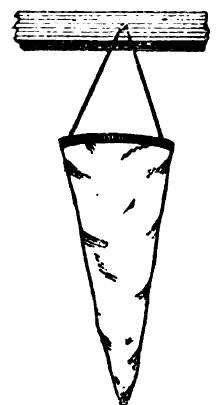
Fig. 2. Cloth or Felt Filter.
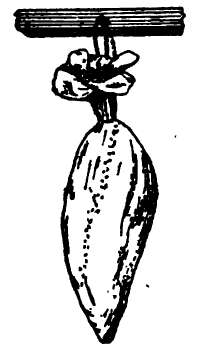
Fig. 3. Drip Bag.
Another serious mistake is sometimes made by putting the juice into bottles so large that much of it becomes spoiled before it is used after the bottles are opened. Unfermented grapejuice properly made and bottled will keep indefinitely, if it is not exposed to the atmosphere or mould germs; but when a bottle is once opened it should, like canned goods, be used as soon as possible, to keep it from spoiling.
Flavor And Quality In GrapeJuice
In the making of fermented grapejuice a great deal of judgment can be displayed and many variations produced so as to suit almost any taste by the careful selection of the varieties of grapes. From the Mission grape, for instance, when fully ripe, a juice would be obtained that would be delicate and simply sweet, without any other taste; from the Muscat we would get that rich musky flavor found in our leading raisins; in the Concord that sprightly foxy taste so well known; in the Catawba or Isabella that fragrance so peculiarly their own, and in the Ina a pleasing, mild, yet pronounced aroma and taste. Thus we might continue along the list.
Equally as pronounced variations in color can be had, as, for instance, almost colorless, yellow, orange, light red, red, and a deep purple.
The richer, sweeter, and better in quality the fruit we use, the richer, sweeter, and better will be our fermented juice. If, on the other hand, the fruit is sour, green, and insipid, the juice will be likewise.
Uses of GrapeJuice
The uses are indeed many. It is used in sickness, convalescence, and good health; as a preventive, restorative, and cure; by the young, by persons in the prime of life, and by those in old age. It is used in churches for sacramental purposes; at soda fountains as a cool and refreshing drink; in homes, at hotels, and at restaurants as a food, as a beverage, as a dessert, and in many other ways. When people become accustomed to it they rarely give it up. When properly prepared, fermented grapejuice can be made to please the eye by its color and attractive appearance, the sense of smell by its aroma or fragrance, the palate by its pleasant flavor.
It is food and drink, refreshment and nourishment, all in one. Not a byproduct, but made from fruit going to waste one of the blessings given us, that some are too careless, others too ignorant, to make use of.
Food Value Of GrapeJuice
The effects of fermented grapejuice on the human system have been studied for a number of years, especially at the socalled grape cures so long in vogue in Europe. A smaller number of investigations have been made in laboratories.
It is quite generally claimed that using a reasonably large amount of fermented grapejuice with an otherwise suitable mixed diet is beneficial and that digestion is improved, intestinal fermentation diminished, and that gains in body weight result. It should not be forgotten that the abundant diet and hygienic methods of living practiced at the grape cures play an important part, but even taking all this into account it seems fair to conclude that some of the good results can be directly attributed to the fermented grapejuice.
Grapejuice contains the same kinds of nutrients as other foods. The percentage of water is high, and thus it resembles liquid foods more closely than solid foods. It is sometimes compared with milk, the most common liquid food. It contains less water than milk, more carbohydrates, and less protein, fat, and ash. Carbohydrates, largely present in the form of sugar, are the principal nutritive ingredients. It is evident, therefore, that grapejuice is essentially an energyyielding food, and may help the body to become fatter, though it can not materially assist in building nitrogenous tissue. Sugars in moderate amounts are wholesome foods, and grapejuice offers such material in a reasonably dilute as well as palatable form. Undoubtedly the agreeable flavor increases the appetite, a by no means unimportant consideration.
Continue to:


My Books

