


Economy. Part 2
Description
This section is from the book "The Home Cook Book", by Expert Cooks. Also available from Amazon: The Home Cook Book.
Economy. Part 2
Return the bone to the soup kettle and allow it to simmer until the bones drop apart. The meat which has been taken out may be utilized in a number of ways. It makes excellent hash. When well seasoned it is not to be despised in the shape of croquettes. With a cup of the stock and a few parboiled vegetables you have a savory stew, or in hot weather it may be inclosed in an aspic jelly. When used in this way soup bones costing forty cents may be made to yield two or three meals of good variety for a large family.
Other Cheap Meats
Sheep's or a beef heart, with a good bread stuffing, is a cheap and very appetizing dish; Sheep's liver, which in England is esteemed as highly as kidneys, is almost given away in American markets. Try it larded and baked, then covered with a rich brown gravy, if you would know how good it can be made. Many cheap cuts of beef can be converted into excellent meats by potroasting. Among them may be mentioned the lean, juicy crossrib, or a solid piece from the lower part of round or face of the rump.
Two pounds of flank, which costs from nine to ten cents a pound, make a very savory dish. The meat is rolled, sautes brown, highly seasoned, then brazed slowly for two hours with just enough water to make a good gravy. The flank rolled makes a good soup, lifting the meat out when cooked and serving with vegetables and horseradish sauce. The stock left may be utilized next day as a rice or julienne soup.
Remember when buying meat for a stew, braze or potroast, it is better economy to pay twelve cents a pound for solid, juicy meat than it would be to pay seven cents for a larger piece which is half bone and fat. It is the same economy that makes the good housewife choose a pound and a half of solid halibut at twenty cents a pound rather than a fivepound cod with skin, head and tail included at six cents a pound.
Among the cheap and nourishing meats yet to mention one might include corned beef, with its cabbage accompaniment, and boiled tongue, which in small towns and villages can be bought very cheap. The aitch bone sells generally at ten to twelve cents a pound and is the best bit of beef for a stew. Next to it come several pounds from the middle cut of the skin, the flank of a large sirloin roast or the upper part of the chuck rib.
Good pieces of the round, which accumulate in small, unsightly portions on every butcher's counter, cost little and, by the aid of the household meat chopper, can be converted into Hamburg steak. I have something of a prejudice against market Hamburg steak, preferring to see with my own eyes the meat which goes through the chopper. It costs less and adds a relish to sausage when it, too, is homemade.
Odd pieces of pork can be had for the watching and at low cost in every market. For the people who like it, tripe provides an occasional good and cheap meal. Three or four pounds of lamb from the forequarter costs ten cents a pound, and is nutritious as a fricassee with brown gravy or as an Irish stew. Nothing makes a nicer stew or broth than a neck of mutton, one of the cheapest cuts of the sheep. Then in pork there is the oldfashioned, savory dish of spare ribs stuffed, while in veal rich stews may be made from the knuckle when cooked for a soup after the method suggested in the making of beef stock.
The Cuts Of Meat
The method of dividing up the carcasses of slaughtered animals varies considerably in different localities. The acaccompanying diagrams illustrate the cuts generally made. On Plates V to X inclusive will be found illustrations of all the principal steaks and roasts of beef and lamb chops.
Making The Most Of Meats
A famous chef once described tersely the slow, simmering process required by a stew or soup. He said: "Never allow the water to laugh, let it smile smile slightly." If every cook could be made to understand what "smiling" means, we would have cheap, tough meat appearing before us made so tender that it would scarcely require a sharpened knife. Instead of this we have expensive cuts which carve with the consistency of shoe leather simply because they have boiled at a broad grin.
If meats which have been boiled be left with the lid off, to cool in their own stock, they will be much more tender and juicy than if lifted from the boiling pot liquor to the platter.
Corned beef is much improved by being cooked the day before it is to be used. Let it cool off in its liquor, then cover, and when needed reheat slowly. Do not allow the liquor to boil, simply allow it to continue at the simmering point until the meat is heated through.
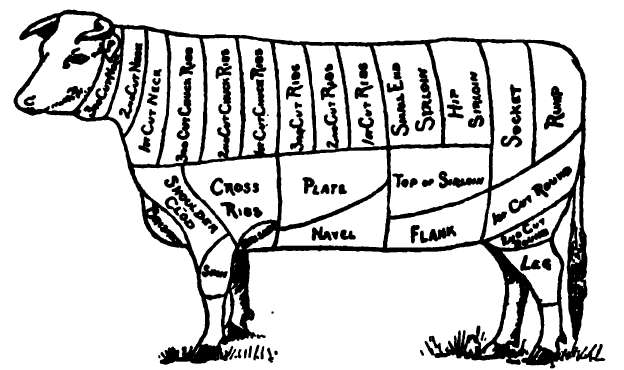
Diagram of Cuts of Beef.

Diagram of Cuts of Veal.
Do not pour the corned beef liquor away. Save it to keep the meat in until the last morsel has been used for hash. Corned beef cold which is kept in the liquor does not seem like a piece of the same creature as when it is left to become dry and hard on an uncovered platter.
A piece of corned beef, even when rolled, frequently presents a ragged, unsightly appearance. Take a pair of sharp, clean scissors, such as ought to hang in every pantry, and trim the meat into presentable shape. Set the trimmings away to be used as hash.
Continue to:


My Books

