


Chapter VIII. How To Cook Poultry
Description
This section is from the book "The Illustrated London Cookery Book", by Frederick Bishop. See also: How to Cook Everything.
Chapter VIII. How To Cook Poultry
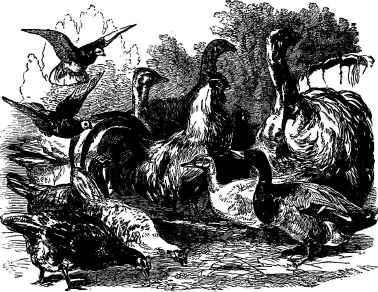
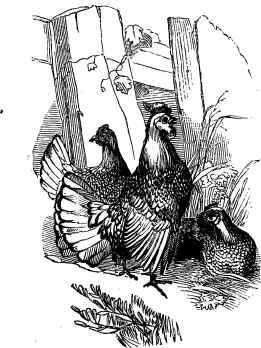
Always have good and fat poultry where possible, in the country you may command it. The best sort for table is the Dorking breed, they are five toed, have white legs, and feathers of a greyish white colour.
About three weeks before you want to use them, six or twelve fowls, according to your consumption, should be put into the coop, and as you kill one or more replace them to keep up the stock; for the first week feed them alternate days with boiled rice and soaked, bread and milk, the remainder of the time mix barley meal with the skimmings of your stockpot and a spoonful of moist sugar, the windows of your poultry house must be darkened.
Fowls should be carefully drawn, so that the gall bladder is uninjured, and should only be done through the vent.
Roast with a brisk and clear fire. A capon will take five-and-thirty minutes, smaller fowls a less time in proportion. A turkey of fourteen pounds will take . two hours; the time will increase or decrease with the weight. The same rule applies to geese, a large one will take an hour and a half, chickens take half an hour, pigeons ten minutes less. It must be understood that the adherence to the time'will depend on the state of the fire, etc.; a slow fire will make a longer time necessary, and at the same time spoil the poultry.
381. How To Bone Birds
Begin to bone any birds by first taking out the breast bone, when you will have sufficient space to remove the back with a sharp knife, and then the leg bones; the skin must not be broken, but the meat of the legs must be pushed inwards.
438. Larks
Be very particular in roasting these birds; melt a little butter, add to it a yolk of egg, and with your paste brush egg all over them, and then bread crumb them, while roasting frequently baste them and flour them, and before you take them up flour and salt them; send them up with some brown bread crumbs.
439. Larks
These nice little birds are in season in November; when they are cleaned, gutted, and picked, truss them, then do them over with yolk of egg, and then roll them in bread crumbs, spit them on a lark spit, and then fasten them on to a larger one; ten or fifteen minutes are enough to roast them in before a quick fire. Whilst they are roasting baste them with fresh butter, and sprinkle them with bread, crumbs till they are well covered with them, fry some grated bread in butter, set it to drain before the fire that it may harden, serve the crumbs in the dish under the larks, and garnish with slices of lemon.
440. Larks - To Roast
Lard and cover them with bacon, or you may only cover one half with bacon and lard the other, roast them, leave under them toasted bread to receive all that falls, leave in the trails for a side dish, they may be served up a variety of ways.
441. Wheateaes
You will dress these the same as larks, taking about fifteen minutes to roast.
Continue to:


My Books

