


How To Cut Meat
Description
This section is from the book "The Illustrated London Cookery Book", by Frederick Bishop. See also: How to Cook Everything.
How To Cut Meat
Beef
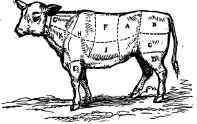
A Bullock marked as cut into joints by the Butcher.

A Sirloin. B Rump. C Aitchbone. D Buttock. E Mouse Buttock. F Veiny Piece. G Thick Flank. H Thin Flank. I Leg.
K Fore Ribs, containing five ribs.
L Middle Rib, containing four ribs.
M Chuck Rib, containing three ribs.
N Shoulder, or Leg of Mutton piece.
0 Brisket.
P Clod.
Q, Neck, or Sticking Piece.
R Shin.
S Cheek.
The baron of beef is formed of the pieces marked A, B, united on both sides.
Veal
The calf is divided into joints by the butcher, upon a system which unite the methods employed for cutting up both beef and mutton.
A The Loin (best end). B The Loin (chump end). C The Fillet. D The Hind Knuckle. E The Fore Knuckle.
F Neck (best end). G Neck (scrag). H Blade Bone. I Breast (best end). K Breast (Brisket).
Pork
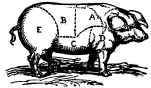
The Pig is thus divided: - A The Fore Loin. B The Hind Loin.
C The Belly, or Spring. D The Hand.
E The Leg.
The spare rib is under the shoulder, which, when removed in a porker, leaves part of the neck without a skin upon it, forming the spare rib. The head is much liked by many, and appears at table dressed in various ways.
Mutton
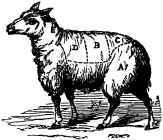
The Sheep is thus apportioned by English butchers.
A The Leg. B Loin (the best end). C Loin (chump end). D Neck (best end).
E Neck (scrag end). F Shoulder. G Breast.
The saddle originally was formed of the two necks, it is now the two loins. The chine is the union of the two necks, but it is very rarely seen at table.
The Scotch plan of carving mutton carcasses, according to a very able article on domestic economy, published by Messrs. Chambers of Edinburgh, differs somewhat from our own, as will be seen by the accompanying diagrams.
English Mode
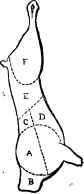
In the English mode, A marked in a circle is the shoulder, separated from the neck and breast; B, the scrag end of the neck, C is the best end, D is the breast, E the loin, and F the leg, which, when formed with E, makes the haunch.
In the Scotch mode, A is the leg, B the loin, which, with the leg, forms the hind quarter; C is the back rib, and D the breast; C and D form the fore quarter; the dotted line across the body denotes where the fore and hind quarters divide.
Scotch Mode
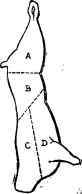
Venison
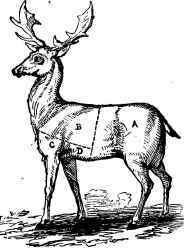
A Haunch. B Neck.
C Shoulder. D Breast.
Buck and Doe Venison are cut up in a similar fashion.
Continue to:


My Books

