


The Rattle-Ran
Description
This section is from the book "Miss Parloa's New Cook Book And Marketing Guide", by Maria Parloa. Also available from Amazon: Miss Parloa's New Cook Book.
The Rattle-Ran
The whole of lower half of the fore quarter is often called the rattle-ran. Diagram No. 17 shows this, and the table following gives the name of the separate cuts :
Diagram No. 17.
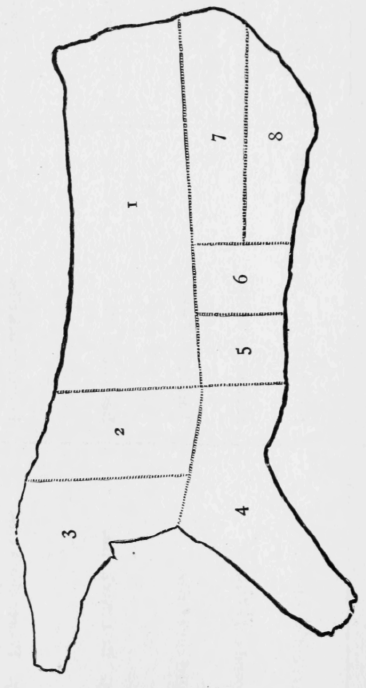
The Rattle-Ran.
Explanation Of Diagram No. 17
Boston. | New York. | Philadelphia. |
I. Rattle-ran. | Plate piece. | Plate piece. |
2. Shoulder of mutton. | Shoulder of mutton. | Shoulder of mutton or boler piece. |
3. Sticking piece. | Sticking piece. | |
4. Shin, thick end of brisket, part of sticking piece. | Shin and thick end of brisket. | Shin and thick end of brisket |
5 and 6. Brisket piece. | Brisket piece. | Brisket piece. |
7. Middle cut or rib plate, | Navel end of brisket | Navel end of brisket. |
8. Navel end of brisket. |
The rattle-ran or plate piece is generally corned, and is considered one of the best cuts for pressed beef. The shoulder of mutton is used for stews, beef a la mode, roasts and steaks, and is also corned. The sticking piece, commonly called the back of the shoulder, but which is really the front, is used for stews, soups, pie meat and for corning. The shin is used for soups, and the brisket and ribs for corning and for stews and soups. One of the best pieces for corning is the navel end of the brisket. The middle cut of the rattle-ran is also corned.
Continue to:


My Books

