


Sturgeon
Description
This section is from the book "The Modern Cook: A Practical Guide to the Culinary Art in All Its Branches", by Charles Elme Francatelli. Also available from Amazon: The Modern Cook: A Practical Guide to the Culinary Art in All Its Branches.
Sturgeon
Comprising Sturgeon d la Beaufort. d la Cardinal. d la Genoise. a la Dauphine. d la Perigord.
Sturgeon d In Bourguignotte. a l'Indienne.
au gratin with fine herbs. d la Russe. d l'Anglaise.
431. Sturgeon A La Beaufort
Choose a small sturgeou, draw, skin, and truss it in the shape of the leter S; braize it in a mirepoix moistened with sherry, or with common broth, and a little brandy. When the fish is done, drain it and put it in the larder to cool; then mask it all over with a coating of quenelle force-meat of whitings; observing that the form of the head should be restored by covering that part of the sturgeon with some of the force-meat mixed with some lobster-coral. Form the eyes, mouth, and gills, with some black truffles cut into shapes for the purpose. Place some fillets of soles previously contises with truffles, crosswise along the back of the sturgeon, allowing the space of an inch to intervene between each fillet of sole, which spaces are to be filled up by the insertion of crayfish tails, trimmed and secured by being stuck into the force-meat in close rows; then cover the fish with very thin layers of fat bacon, place it on a drainer, and put it in the braizer with a little of the mirepoix in which it has been braized. About an hour before dinner-time, put it in the oven or on a slow fire, with live embers upon the lid, and after the fish has simmered gently, without boiling, during the time allotted, take it out of the braize upon the drainer, and after divesting it of the layers of bacon, slide it off the drainer on to its dish; sauce it round with a rich Matelotte sauce made with Sauterne wine, add also some of the liquor in which the sturgeon has been braized; garnish round with alternate groups of the soft roes of mackerel (cut in halves, blanched, and fried in batter) and some dessert-spoon quenelles of lobster.
432. Sturgeon A La Cardinal
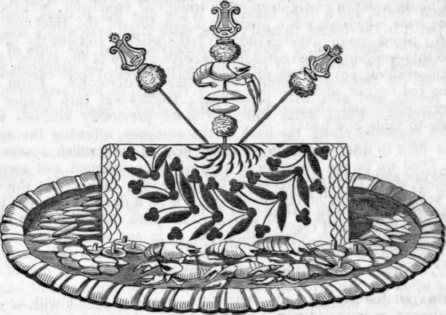
Procure a prime cut of sturgeon weighing about 12 Ibs.; remove skin in the following manner: - Place the piece of sturgeon on the kitchen table, lengthwise before you, so as to have a command on either side; then take a long thin-bladed knife, insert its point immediately between the flesh and skin, run the knife right up, keeping close to the back fin, and minding that the edge of the knife be kept to the left; press, with the palm of the left hand, on the skin of the fish, drawing the knife to and fro, so as to sever the skin from the flesh; and after effecting this on one side, repeat it on the other. Replace the skin over the sturgeon, and fasten it on with a string, in order to preserve the color of the fish; at the same time taking care to give shape and appearance to the sturgeon. Then put it into a fish-kettle or braizing-pan on the drainer belonging to it, moisten with a good wine mirepoisc, and set it to braize with lire under and over. If the quality of the sturgeon be good, about four hours' gentle boiling will suffice to braize it; the fish must be well basted with its liquor every now and then. When the sturgeon is done, take it up, remove the skin, drain, and afterward mask it with some stiff glaze, in which has been mixed some pounded lobster-coral in sufficient quantity to give the sturgeon a bright scarlet color ; form on its centre a palm or star, with some confixes fillets of soles. The ornamental skewers that appear in the woodcut, must, if used - which is not strictly essential - all be garnished with a large truffle, crayfish, mushroom, quenelle, and truffle. Pour some Cardinal sauce (No. 48) round it, garnish with a border of tails of very small lobsters, and alternate groups of small quenelles of whiting, button-mushrooms, and truffles.
Continue to:


My Books

