


Turbans And Mazarines
Description
This section is from the book "The Modern Cook: A Practical Guide to the Culinary Art in All Its Branches", by Charles Elme Francatelli. Also available from Amazon: The Modern Cook: A Practical Guide to the Culinary Art in All Its Branches.
Turbans And Mazarines
Comprising Turban of Ox-palates, d la Perigueux. Turban of Fillets of Hares, d la Conti. Fillets (of Fowls, d la Prince ,, Fillets of Soles, d In Ximenes.
de Galles. Mazarine of Whitings, a la Venitipane. Fillets of Rabbits, d la Finan- Fat Livers, d la Toulouse.
cicre.
798. Turban Of Ox-Palates, A La Perigueux
Braize eight ox-palates, and when done, place them between two dishes, to press them flat; prepare about 2 lbs. of gratin force-meat
(No. 249); decorate or contises twelve minion fillets of fowls, and cover them with thin layers of bacon till wanted.
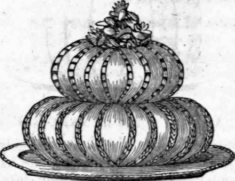
Next, roll out about 4 oz. of firm common paste, to the size of a dessert-plate, and bake it in a slack oven; this is to serve for a foundation to raise the entree upon. Next, trim the ox-palates,.split each in two with a sharp knife, in the same way as thin layers of bacon are cut; trim eight of these, spread the rough side with a thin layer of the gratin force-meat, then roll them up; put the piece of paste before alluded to on a round baking-sheet; spread it with a layer of the force-meat, a quarter of an inch thick, and after having trimmed the rolled ox-palates, to make them fit in with each other in circular order, place them firmly together on the foundation of paste prepared to receive them, taking care to put a little force-meat between each, to fill up the fissures, and unite them ; upon each fissure, one of the decorated fillets must be neatly laid, and turned under to secure it. The remaining eight pieces of ox-palates must then be trimmed, garnished with force-meat like the former, and afterward cut to the size of two-thirds of the others, and with these smaller rolls of ox-palates, a second tier must be formed upon the first, in similar fashion, and upon each joining, a decorated fillet is to be placed likewise. Any roughness occasioned by the force-meat must be neatly smoothed over with a knife, dipped in water; a thick carrot, or piece of bread, cut in the shape of a pillar, and covered with fat bacon, should be placed in the centre of the entree, to support its shape while being baked. The whole of the turban must be covered in with thin layers of fat bacon, and these must be secured on by means of a thick band of buttered paper, cut in slits round the base (to enable it to fit closer), and secured round the entree with string : this will serve also to keep the turban in shape. One hour and a half before dinner-time, put the turban in the oven to be baked ; when done, remove the paper, etc, and with the end of a large skimmer, place the turban on its dish, fill the centre with a ragout of small truffles, pour some Perigueux sauce (No. 23) round the base of the entree, lightly glaze the palates, without touching the fillets - which must be kept as white as possible - and serve.
799. Turban Of Fillets Of Fowls, A La Prince De Galles
Prepare some quenelle force-meat of fowls (No. 242) or veal; and with part of it fill a plain cylindrical mould, measuring about four inches high and six in diameter, previously buttered inside. This must be steamed in a covered stewpan, with a little water in it; and when done, turned out of the mould upon a plate, and allowed to cool ; it should then be placed upon a foundation of baked paste, the angles of the quenelle rounded, and the whole of it covered with a thin coating of force-meat: upon this turban of quenelle, six larded fillets of fowls should be placed, with the point made to turn over the top; between each of these, insert a decorated minion fillet; cover the latter with thin layers of fat bacon, and secure the entree round with a band of buttered paper made fast with string. Three quarters of an hour before dinner-time, put the turban in the oven to be baked; when it is done, remove the paper and the bacon from the small fillets, glaze the larded fillets brightly, garnish the well of the entree with a Parisian ragout (No. 203), pour some of the same round the base, and serve.
Continue to:


My Books

