


The Whole Art Of Carving. Part 3
Description
This section is from the "The American Housewife" book, by Experienced Lady. Also available from Amazon: The American Housewife.
The Whole Art Of Carving. Part 3
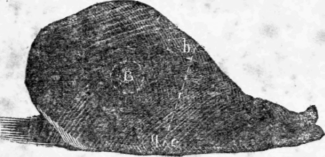
12. Fore Quarter Of Lamb
Separate the shoulder from the breast and ribs, by passing the knife under, in the direction of a, b, c, and d. Be careful to keep it towards you horizontally, to prevent cutting the meat too much off the bones. If grass lamb, the shoulder being large, put it into a another dish. Squeeze the juice of half a Seville orange or lemon on the other part, and sprinkle a little salt and pepper; then separate the gristly part from the ribs, in the line e, c, and help either from that or from the ribs, as may be chosen.
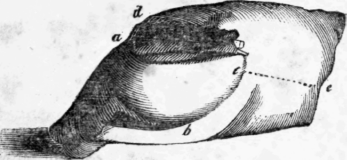
13. Haunch Of Venison
First cut it down to the bone, in the line d, c, a, then turn the dish with the end a towards you; put in the point of the knife at c, and cut it down as deep as you can in the direction c, b. Thus cut, you may take out as many slices as you please, on the right or left. As the fat lies deeper on the left, between b and a, to those who are fond of fat, as most venison eaters are, the best flavored and fattest slices will be found on the left of the line c, b, supposing the end a turned towards you. Slices of venison should not be cut too thick nor too thin, and plenty of gravy given with them.
14. Round Of Beef
This is cut in the same way as a fillet of veal. It should be kept even all over. When helping the fat, be careful not to hack it, but cut it smooth. A deep slice should be taken off before you begin to help, as directed in the edge-bone.
15. Brisket Of Beef
This must be cut lengthwise, quite down to the bone, after separating the outside or first slice, which must be cut pretty thick.
16. Leg Of Pork
This joint is sent to the table, whether boiled or roasted, as a leg of mutton, roasted and cut up in the same manner. The close firm flesh about the knuckle is by many reckoned best.
17. Haunch Of Mutton
This is formed by the leg and part of the loin, cut so as to resemble a haunch of venison, and is to be helped at table in the same manner.

18. Goose
Turn the neck end of the goose towards you, and cut the whole breast in slices on each side of the bird, but only remove them as you help each person, unless the company is so large as to require the legs likewise. Turn the goose on one side, and then take off the leg by putting the fork into the small end of the leg bone, pressing it close to the body; and, having passed the knife in the line e, d, turn the leg back, and, if a young bird, it will easily separate.
To take off the wing, put your fork into the small end of the pinion, and press it close to the body; then put in the knife at c, and divide the joint, taking it down in the direction c, d. Nothing but practice will enable people to hit the joint exactly at the first trial. When the leg and wing of one side are done, go on to the other; cut off the apron in the line f, e, g, then take off the merry-thought in the line o, i. The neck bones are next to be separated as in a fowl, and all other parts divided the same.
19. A Fowl
A boiled fowl's legs are bent inwards, but before it is served, the skewers are to be removed. Lay the fowl on your plate, and place the joints as cut off on the dish. Take the wing off, in the direction of a to b, in the annexed engraving, only dividing the joint with your knife ; and then, with your fork, lift up the pinion, and draw the wings towards the legs, and the muscles will separate in a more complete form than if cut. Slip the knife between the leg and body, and cut to the bone; then, with the fork, turn the leg back, and, if the bird is not old, the joint will give way. When the four quarters are thus removed, take off the merry-thought from a, and the neck bones, these last by putting in the knife at c, and pressing it under the long broad part of the bone, in the line c, b; then lift it up, and break it off from the part that sticks to the breast. The next thing is to divide the breast from the car-cass, by cutting through the tender ribs, close to the breast, quite down to the end of the fowl; lay the back up, put your knife into the bone, half way from the neck to the rump, and on raising the lower part, it will readily separate. Turn the neck towards you, and very neatly take off the two sidesmen, and the whole will be done. As each part is taken off. it should be turned neatly on the dish, and care should be taken that what is left should go properly from the table. The breast and wings are looked upon as the best parts, but the legs are most juicy in young fowls. After all, more advantage will be gained by observing those who carve well, and a little practice, than by any written directions whatever.
Continue to:


My Books

