


The Whole Art Of Carving
Description
This section is from the "The American Housewife" book, by Experienced Lady. Also available from Amazon: The American Housewife.
The Whole Art Of Carving
Preliminary Remarks.
The carving knife should be light, of middling size, and of a fine edge. Strength is less required than skill in the manner of using it; and to facilitate this, the butcher should be directed to divide the joints of the bones of all carcass joints of mutton, lamb, and veal, (such as neck, breast, and loin,) which then may easily be cut into thin slices, attached to the bones. If the whole of the meat belonging to each bone should be too thick, a small slice may be taken off between every two bones.
The more fleshy joints (as fillets of veal, leg or saddle of mutton, and beef,) are to be helped in thin slices, neatly cut, and smooth. Observe to let the knife pass down to the bone in the mutton and beef joints.
The dish should not be too far off the carver, as it gives an awkward appearance, and makes the task more difficult. Attention is to be paid to help every one to a part of such articles as are considered best.
In helping fish, take care not to break the flakes, which in cod and very fresh salmon are large, and contribute much to the beauty of its appearance. A fish knife not being sharp, divides it best. Help a part of the roe, milt, or liver, to each person. The heads of carp, part of those of cod and salmon, sounds of cod, and fins of turbot, are likewise esteemed niceties, and are to be attended to accordingly.
In cutting up any wild fowl, duck, goose, or turkey, for a large party, if you cut the slices down from pinion to pinion, without making wings, there will be more handsome pieces.
1. Sirloin Of Beef
This may be begun at either end, or by cutting in the middle. It is usual to inquire whether the outside or inside is preferred. For the outside, the slice should be cut down to the bones, and the same with every following helping. Slice the inside likewise, and give with each piece some of the soft fat. The inside, done in the following manner, is excellent: Have ready some shaiot vinegar, boiling hot; mince the meat large, and a good deal of the fat; sprinkle it with salt, and pour the vinegar and the gravy on it. Help with a spoon as quick as possible, on hot plates.
2. Aitch Or Edgebone Of Beef
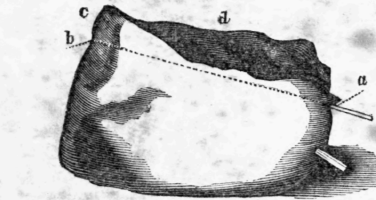
Cut off a slice, an inch thick, all the length from a to b, and then help. The soft fat, which resembles marrow, lies at the back of the bone, below d - the firm fat must be cut in horizontal slices at the edge of the meat, c. The skewer used in keeping the meat together while boiling, is shown at a, which should be drawn out before served up ; or, if necessary to leave it in, place instead one of silver.
3. Shoulder Of Mutton
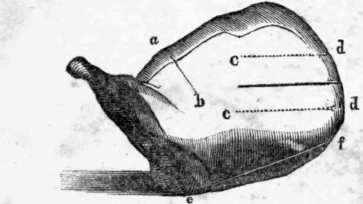
This is a very good joint, and by many preferred to the leg; for, if properly roasted, it abounds in gravy, and produces many nice bits. The figure annexed represents it as laid in the dish, with its back uppermost. It should first be cut in the hollow part, in the direction a, b, and the knife passed deep to the bone. The best part of the fat lies on the outer edge, and it is to be cut out in thin slices, in the direction/*. If many are at the table, and the hollow part cut in the line a, b, is eaten, some very good and delicate slices may be cut out on each side the ridge of the blade bone, in the direction c, d. The line between these two dotted lines is that in the direction of which the edge or ridge of the blade bone lies, and cannot be cut across. It is necessary to wind writing paper around the shank, as in the leg, provided you wish to handle it. The lower side of the shoulder has two cuts abounding in gravy. The part in the direction i, k, is lean; the other, g, h, is very fat.
4. Knuckle Of Veal
A knuckle of veal cuts in neat slices only in one direction, viz.: from a to b. The line dt c, divides two bones, which it is necessary to separate in order to get at the best marrowy fat portion-also cut asunder the knuckle bones.
Continue to:


My Books

