


Familiar Talk. Tea, Tea-Making, And Tea-Drinking
Description
This section is from the "The National Cook Book" book, by Marion Harland And Christine Terhune Herrick. Also available from Amazon: National Cook Book
Familiar Talk. Tea, Tea-Making, And Tea-Drinking
Dogberry figured as a masculine type of a mighty class when he opined that "reading and writing come by nature."
A modern Mrs. Dogberry would give prominence among things that are too easy to be learned to Tea-Making. She troubles herself little, to begin with, with the quality of the tea she buys. So long as it is not costly, if she be in moderate circumstances, she takes what is offered her by her grocer and asks no questions. If she be wealthy she satisfies herself that she buys the best brand of tea when she orders the highest-priced.
Brands of tea are many, and each is warranted to be superior to all the rest. As a rule, avoid cheap - and bulky - teas. They are largely adulterated with foreign and domestic herbs, the former being represented by dried huckleberry leaves, the latter by dried-over teas that have been already used, and by inferior qualities which the Chinese will not drink. Green teas are often "doctored " by dyes in which Prussian blue holds a conspicuous place.
Again, teas may be high in price and pure in quality and be done to their death and the injury of the drinkers by the making - or marring.
We are all, unhappily, well acquainted with the astringent flavor of stewed tea, which has been left to simmer upon the range or hob, until all the tannic acid latent in the herb is drawn out into the decoction. It is even less drinkable when (nominally) made of unboiled water, reminding the partaker thereof of tepid dish-water, scantily or abundantly sweetened. Such is the beverage usually compounded at country hotels and boarding-houses. It is almost as usually served in cups such as were complained of by the witty tourist who objected to "sipping her tea over the edge of a stone wall."
It is still a matter of curious inquiry who established the custom of tea-drinking. It must have been a woman, and it is a comparatively modern "fad." Queen Elizabeth and her more refined sister, Mary, had beer - and plenty of it - for breakfast. Marie Stuart took nothing stronger than perfumed eau sucre. Without ice, too. Queen Anne consumed incredible quantities of brown stout, which, if newspaper gossip is to be received as evidence, is still popular among feminine sovereigns.
Everybody has heard of the good Yankee house-mother, one of the first settlers in New England, whose son, a seafaring man, brought to her a small package of tea from China. The good soul, delighted with the gift, boiled it, strained off and threw away the water, and served the leaves as greens, presumably with the accompaniment of salt pork or corned beef. We know that our Revolutionary foremothers used tea, but if they had the same fondness for it their descendants display, they could hardly have given a greater proof of their patriotism than when they encouraged husbands and sons to throw the precious cargo overboard.
Women of all classes become each year more dependent on this, their favorite beverage. Men, as a rule, prefer coffee - possibly because the proper mode of preparing it is more generally understood, and, consequently, the chances are in favor of its palatableness. Our "comfort" is frowned upon by the stronger sex as "weak, sloppy stuff," disapprobation justified by the fact that most wives and mothers are so deficient in the knowledge, or derelict in the practice of the correct method of brewing the "ladies' nectar," that, on nine tables out of ten, it is a caricature of the fragrant amber fluid that should steam in the cups. One good woman goes so far as to affirm that while green tea should "only be drawed quite a while, black tea must always be boiled"
Yet the one and only way is so simple that the wonder is how a child could err therein.
When you use good mixed tea, the old saying, "A level tea-spoonful for each person and one for the pot," is about as good a rule for quantity as you can follow, when the number of drinkers is not more than six or eight.
First, and above all, have the water boiling. Not "just off the boil," not already boiled, but actually boiling. Few persons appreciate the great difference between water that has been cooked some time and that which has just attained the point of ebullition. One has life and sparkle; the other is as flat as two-days' uncorked champagne. You will be obliged to give this your personal supervision, as the average servant is without conscience - and sense - in the matter. She will state, with the utmost sang-froid, that the water must be all right, for "it boiled an hour ago."
The only safe and the most convenient way is to make your tea on the table.
Arrange on the tray in front of you a bowl of block sugar, cups, spoons, cream-pitcher, and a small tea-canister. This last article may be of silver, solid or plated, or of expensive, or cheap, though pretty, china. There is in every china-shop such a large variety of them that the housewife can easily find one to suit her - or her purse. When of porcelain, they have two tops, that the tea may not lose its strength, and are daintier and more convenient when not large. For fifty cents one can get a bit of pretty Japanese ware that would grace any board. When you buy several pounds of tea, keep it in a tightly closed canister, and fill your little caddy from this.
Try always to have cream for your tea. You need so small an amount that you will scarcely notice the extra cost, and it adds immeasurably to the rich flavor of the beverage. Pitchers are now made in such tiny, dainty shapes, that your half-pint of cream will fill one to overflowing.
Use a small silver tea-strainer, that the minute leaves and sticks which escape through the spout may not get into the cups. A person who habitually drinks unstrained tea can scarcely imagine the de-appetizing effect it produces upon one unaccustomed to the sight of the particles, the nature of which is doubtful, floating about on the surface. It is sometimes, especially during the summer months, unpleasantly suggestive of dismembered flies and other insects. Years ago, before the introduction of the strainer, young girls called these atoms of leaves "beaux," and when the tea was drunk, delighted in telling fortunes from the mass of sediment in the bottom of the cup. This was certainly a graceful way of disposing of a most disagreeable subject. But let us, of a more enlightened time, use strainers.
At your right hand have a brass, copper, or silver kettle, heated by a small spirit-lamp. Pretty brass kettles range in price from $3.50 to $25.00. Some of them rest on a standard on the table, while others depend from a high crane set on the floor at the pourer's right hand. These cranes are of iron, fashioned usually in the shape of the figure 5, and are "the thing" for five-o'clock tea.
Kettles of solid silver are useful, so long as they do not (as sometimes happens) melt when heated by the flame of the alcohol lamp. They should never be placed on the stove.
Fill your kettle with hot water, and light the lamp. Put into the tea-pot the requisite quantity of tea; when the water boils pour enough on the leaves to cover them, and put the kettle again over the lighted wick. Cover the tea-pot closely. At the end of three minutes the steeping process will be completed, and you may fill the pot with the still boiling water. After it has stood a minute longer the delicious drink is ready to be enjoyed.
If you cannot afford to buy, and if nobody presents you with one of these almost necessary kettles, make up your mind always to go into the kitchen yourself and ascertain that the water is boiling before allowing the servant to wet the tea.
One of the requisites in a good cup of tea is to have it very hot. This object should not be attained by allowing the pot to stand on the side of the range, or, after the manner of our grandmothers, on the hob, where it is almost sure to stew and be ruined, but by covering it while on the table with a cosey; or you may have a basket-cosey. This is a small, round hamper with a wadded lining, and holds a Japanese tea-pot. The cover of the cosey clamps down, and as the spout protrudes through an opening in the basket the tea may, if desired, be poured without removing the pot from its warm nest. Different sizes of the ham-per-cosey are kept at Japanese stores.
To make a cosey, cut two semicircles of some thick, rich-colored material, such as tricot, felt, plush, or velvet, and join these at the top and sides. Cut two half-circles a little smaller than the others, of very heavy wadding, and still another pair of satin, or sateen, for the lining. Fit the wadding inside of this, and quilt or tack the wadding to the lining to prevent its slipping. The seams at sides and bottom should be finished with a silk cord fastened in loops at the tops and corners. When finished, the whole fits over the tea-pot like a snug cap.
Before making the cosey you may have the sides stamped with your initials, a design, or an appropriate motto. I have seen on the table of a friend a pretty one, the material of which was peacock-blue tricot. Upon one side was embroidered a branch of tea-flowers, while the other bore the words:

The housekeeper who has once known the abiding comfort of a cosey would wrap up her tea-pot in a heavy towel, or improvise a covering out of still more unlikely material, rather than do without an adjunct to the tea equipage that secures the triple end of conserving heat, strength, and aroma.
The tea-tray must always be covered with a cloth. A tasteful design in outline for a tray-cloth is traced around the border, and runs :
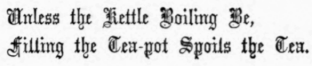
Do not use thick china. For a small sum you can purchase pretty porcelain cups and saucers. The tea drunk from one of these will taste better than if partaken of over the aforementioned "stone wall."
The graceful fashion of afternoon tea has done and is doing more to make simple and easy what has grown in American society to be the "business of entertaining " one's friends than anyone who has not studied the subject is willing to believe. The tea equipage, as arranged upon a rustic stand on the veranda in summer, and near the library fire in winter, typifies home comfort and hospitable cheer to those who are used to the genial refreshment between four and six o'clock every afternoon.
The modest display and the offered dainties involve no disturbance in the household machinery. A few cups and saucers, a jar of dinner or Albert biscuits, or a plate of thin bread-and-butter, with, now and then, a dish of buttered scones; the tea-kettle and stand; the tea-pot and caddy, a sugar-dish, and a cream-jug - and voila tout / It costs a maid but a few minutes' work to set it all in place, and to remove the tray when the canonical hour is over. The hostess makes and dispenses the tea with her own hands, a young girl visitor, or the son of the house, or any privileged guest, passes the biscuit-jar. The spirit of the hour is ease and good-will. Wits arouse and tongues are unlimbered under the influence of the fragrant nervine.
In summer give your guests their choice between hot and iced tea, and if the latter be chosen, pass sliced lemon and Jamaica rum for those who care to disguise the flavor of what is good enough in itself to satisfy the born or educated tea-lover.
Continue to:
Random recipes from the book:
- Orange Roly-Poly
- Picklette
- Scalloped Cucumbers. (No. 2.)
- Veal Souffle
- Coffee Ice-Cream
- Deviled Chicken With Oyster Sauce


My Books

