


Hickory Nut
Description
This section is from the "American Horticultural Manual Vol2" book, by J. L. Budd. Also available from Amazon American Horticultural Manual, Part Two.
Hickory Nut
It may truly be said that the best native varieties of the Shagbark species of Hickory have been for a century a leading favorite nut of the Northern States, especially with the rural population; yet the supply up to the present has been mainly from the native reserved trees of the pasture, forest, or field. At this time, however, the propagation of select thin-shelled varieties has been attempted in several Northern States (289).
Some Desirable Hickory Nut Varieties
Dover
Size medium, angular, broad at base, with point at base; shell quite thin; meat plump and good. Pennsylvania.
Eliot
Medium in size, compressed, ovate, with angles; shell thin; good. Connecticut.
Hales (Hales' Paper Shell)
Large, inclined to be four-angled; quality best; shell very thin. Becoming commercial. New Jersey.
Jackson
Large, oval, somewhat compressed; quality very good. Ohio.
Learning
Large, quite thin-shelled, and cracking without breaking the halves. Missouri.
Meriden
Large, oblong, compressed; quality good, with plump kernels; shell not as thin as some select sorts. Connecticut.
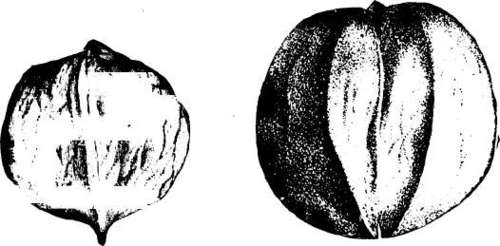
Jackson. Woodbourn.
Milford
Medium to large, ovate, compressed; shell quite thin; quality very good. Massachusetts.
Rice
Medium to large, ovate; shell thin. Locally highly prized. Ohio.
Woodbourne
Large, smooth, ovate; quality best. Shell quite thick. Pennsylvania.
In most cases the descriptions given above are from the valuable report of Mr. S. B. Hodges, of the Division of Pomology, on native and introduced nuts. But the varieties selected are actually offered at this time by some of the nurseries of the States mentioned in connection with each variety. Up to the present the largest and most perfect nuts in all respects have originated west of the Mississippi, in Missouri and Arkansas, but as yet they have not been propagated so far as is known.
Continue to:


My Books

