


Cactuses Indoors And Out. Part 3
Description
This section is from the book "The American Garden Vol. XI", by L. H. Bailey. Also available from Amazon: American Horticultural Society A to Z Encyclopedia of Garden Plants.
Cactuses Indoors And Out. Part 3
"8. The Northwestern Region, comprising the northern parts of the state of California, the territories of Utah. Oregon and Washington. This region has so far furnished only a single opuntia (from eastern Oregon), common also to the Missouri region".
Later researches have increased the number of species, but their relative distribution remains about the same.
The more general distribution of cactuses is well told by Grisebach in his Vegetation der Erde : "The dry climates of America are most sharply distinguished from similar places in other parts of the world by their cacti. These comprise a large and distinct family, native only to America. Cactuses reach their greatest perfection in the tropical zone, upon the rocky plains of Mexico and upon the Andes of South America. In the Colorado region, they shrink during the winter from loss of sap and assume a red color, as if a continual period of growth were a necessity which they cannot easily satisfy. The southern prairies have as great a variety of peculiar forms as the tropics, and all the principal forms of the family are found there. But northward the number of species rapidly diminish, the large and massy ones are wanting, and beyond the Missouri, at Rainy Lake (49°), there only remains one species, Opuntia Missouriensis. This species here marks the extreme limit of this type of vegetation. In the region of the Missouri this species is very common, being one of the characteristic features of these prairies, and the more so as no cactus forms are found in the North American woods.
"The succulent forms which unite the Mexican flora with that of the southern prairies often forms, upon the highlands of Mexico, the most abundant and characteristic product of the dry and rocky soils. Nearly all the cacti found in our greenhouses come from Mexico. There they are found in nearly all parts of the country; a few mamillarias grow at an elevation of 11.000 feet. Only the phyl-locactus, which is never found upon the prairies, and whose stem has the flattened form of a leaf, is limited to the shady woods of the hot regions.
"Upon the cliffs of the West Indies the cereus is found in great profusion, being over twenty feet high. It was once thought that these had been carried from the continent, but a more careful examination proved that they are endemic, and therefore to be considered as belonging to the natural vegetation of these islands.
"In South America, north of the equator, as in Mexico, the cactus is an indication of extreme heat and drouth. No cactuses are found on the bay Choco, but on the coast of Venezuela they are sometimes the predominating form of vegetation. On the seashore of La Guayra, they consist of branched cereuses and opun-tias ; from the hot cliffs spring the melocactus, while the mamillarias seek the shady places. So here the cacti extend from the sea level to an elevation of 2,000 feet, where the forests begin.
"In no part of Brazil are the cactuses, the branched pillars of the cereus and the Hat-stemmed opantia, so numerous as in the plateaus. They also flourish well upon the light soil of the open woods. The Brazilian forms of cacti are closely related to those of Venezuela and Mexico.
" They are also very abundant in the Andes, being found westward from the eastern ridge, and are especially numerous in the highlands of the Pacific slope. They form the most important connection between the flora of the Mexican and Peruvian Andes. On parts of the pampas the cactus forms nearly the only covering of the soil. The pampas seem generally to be too moist for the cactus, but on the Chamarsteppe they are found both in the bush and in the forest. They also appear along the Parana, where the clay soil dries out. Here grows one of the largest species, a pillar-cactus, attaining a height of from 20 to 30 feet. On the steppe of Cordove a large opuntia is found, having white thorns 6 to 9 inches in length. Twelve smaller species have been distinguished near Mendoza; among these, cereus, opuntia, mamillaria, in their different forms. As in the prairies, these forms are found in the higher latitudes, but their number constantly diminishes. In Patagonia only the Opuntia Darwinii is found, in the same manner as in Missouri. In the Andes mountains, from Santiago to Mendoza, there are found several species of melocactus and opuntia, growing at an elevation of 12,000 feet.
They are covered with a woolly material, and are quite small".
The distribution of the cactus-form euphorbias is epitomized as follows by the same author :
"The fleshy euphorbias in the Old World take the place of the cactuses in New World. In the Sahara they are not very abundant, as their African center is in the Cape region. A Nubian euphorbia, E. candelabrum, grows to a height of 30 feet, spreading its branches far apart. Euphorbias are also found in the Kalahari desert, which contains many of the forms found in the Sahara. Upon the barren, rocky soil of the Karroo-steppe, in the Cape region, all sizes of cactus-like euphorbias may be found, while the naked forms grow abundantly around Algoa Bay.
"Only one form of euphorbia is said to appear in Australia, where it grows on the steppes of Spencer's Gulf.
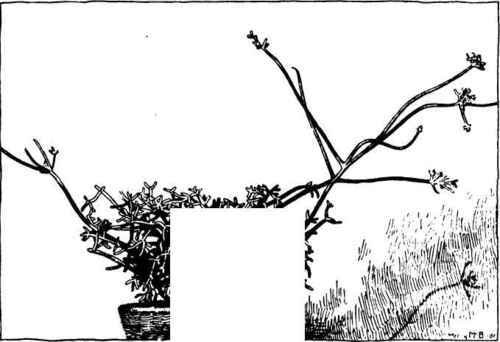
Fig. L. Rhipsalis salicornoidbs.
"In the Canary Islands the euphorbias are found growing at a height of 1,500 feet on the north side and 2,500 feet on the south side of Mt. Teneriffe. The cactus-like euphorbias are very abundant; and the leaf-bearing kinds, E.balsamifera and E. Regis-Jubte, are also prominent among the other endemic forms.
"Many of the euphorbias of the Oceanic Islands resemble those of the Soudan, thus forming a connecting link between the vegetation of these islands and Africa".
All this stretch of vision leads us to the still broader ambition to know what are the general peculiarities of xerophilous or desert plants and regions. And here we can do no better than to quote Baker in his inimitable sketch of Botanical Geography, omitting some of the examples :
Continue to:


My Books

