


Cape Cod Cranberries. A Distinctively American Industry - Its Moods And Tenses
Description
This section is from the book "The American Garden Vol. XI", by L. H. Bailey. Also available from Amazon: American Horticultural Society A to Z Encyclopedia of Garden Plants.
Cape Cod Cranberries. A Distinctively American Industry - Its Moods And Tenses
CRANBERRY-GROWing is the most unique of our horticultural industries. It is entirely unlike anything else. All one's knowledge of gardening and fruit growing in general is of no avail when he undertakes to grow the cranberry. He must lay aside his common notions of soils and tillage, and even discard the very tools which from boyhood he has considered the essentials to any kind of cultivation.
The cranberry-growing sections of the country are few and scattered. The Cape Cod district is the pioneer ground of cranberry culture, and it still undoubtedly holds first rank in general reputation. The country in which these Cape Cod berries is produced is a most peculiar and interesting one. In fact, it is a surprise to anyone not intimately acquainted with it.
Let the reader lay before him a map of Massachusetts, and let him locate Plymouth and Barnstable counties upon its eastern extremity. Upon the south, Buzzard's bay thrusts itself between the two counties, and all but cuts off the long and low hook which stretches eastward and northward to Cape Cod. In provincial parlance the Cape Cod region includes all the peninsular portion of the state, beginning with the lower and eastward projection of Plymouth county. The cranberry region extends from this eastern portion of Plymouth county eastward to the elbow of the peninsula, or, perhaps, even farther.
Upon one of the upper arms of Buzzard's Bay the reader may locate the old and quaint town of Wareham. Here the tides, flow over long marshes bordering the inlet, and rise along the little river which flows lazily in from the Plymouth woods. Here the sea-coast vegeta-ion meets the thickets of alder and bay berry and sweet fern with their dashes of wild roses and viburnums. And in sheltered ponds the sweet water-lily grows with rushes and pond weeds in the most delightful abandon. In the warm and sandy glades two dwarf oaks grow in profusion, bearing their multitude of acorns upon bushes scarcely as high as one's head. The dwarf chestnut oak is often laden with its pretty fruits when only two or three feet high, and it is one of the prettiest shrubs in our eastern flora.
We drive northward over the winding and sandy roads into the town of Carver, where the largest cranberry plantations are located. We are now headed towards Plymouth, and our journey lies in the "Plymouth woods." And here the surprises begin! Do you look for fields of corn and grass, and snug New England gardens, and quaint old houses whose genealogies run into centuries ? Yes, you are picturing an old and over-worn country, from which the impetuous youths have long ago fled to the new lands of the west. But while we are busy with our expectations, we are plunging into a wilderness ! - not a second growth, half-civilized forest, but a primitive waste of sand and pitch pine and oaks ! The country has never been cleared, and it is not yet settled ! And in its wilder portions deers are still hunted and lesser game is frequent! And only fifty miles away is the bustling hub of the universe !
This Cape Cod region is but a part of the sandy waste which stretches southward and westward through Nantucket, along the north shore of the sound and throughout a large part of Long Island; and essentially the same formation is continued along the Jersey seaboard.
Similarities of soil and topography are always well illustrated by the plants they produce. The "pine barren" flora of New Jersey reaches northward into the Cape country, only losing some of its more southern types because of the shorter and severer seasons. But more diligent herborizing will no doubt reveal closer relationship between New Jersey and Cape Cod than we now know. An instance in my own experience illustrates this. The striped sedge (Carex striata, var. brevis) is recorded as a rare plant, growing in pine barrens from New Jersey southward, and yet in these Plymouth woods, in the half sandy marshes, I found it growing in profusion. Even eastern Massachusetts is in need of botanical exploration 1 So the floras run along this coast ; and it is not strange that Cape Cod and New Jersey are both great cranberry producing regions.
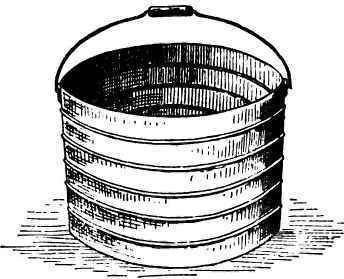
Fig. 2. Cranberry Measure.
The country comprises an alternation of low, sandy elevations and small swamps in which the cassandra, or leather-leaf, and other heath-like plants thrive. The pitch pine makes open and scattered forests, or in some parts oaks and birches and other trees cover the better reaches. Fire has overrun the country in many places, leaving wide and open stretches carpeted with bear-berry (arctostaphylos) and dwarf blueberries. There are no fences, no improvements, except such improvised structures as may be seen now and then about some isolated cranberry bog. At one place we came suddenly upon a school house of perhaps twelve by twenty, standing lonely and bare in the midst of a scrub oak wilderness, with not a house in sight. Clear and handsome little lakes are found in some parts of the wilderness, and upon the banks of one we found a hermitage where a half dozen Boston men shut themselves off from the world in the summer months. Everywhere one finds clear and winding brooks, abounding in trout. And over all (he open glades, the great-flowered aster (Aster spectabilis) is brilliant in the autumn sun.
It is in the occasional swamps in this sandy region that the cranberry plantations, or " bogs" as they are called in Massachusetts, are made. In their wild state these bogs look unpromising enough, being choked with bushes and brakes, as shown in the corner-piece of Fig. 1, page 582. It has required considerable courage to attack and subdue them. I am filled with a constant wonder that the sandy plains are not also utilized for the cultivation of blueberries. These fruits now grow in abundance over large areas, and they are gathered for market. It would only be necessary to enclose the areas, protect them from fire, and remove the miscellaneous vegetation, to have a civilized blueberry farm. Certainly cranberry and blueberry farms would make an interesting and profitable combination. The expense of growing the blueberries would be exceedingly slight, and the crop would be off before cranberry picking begins. With greater attention given to the crop, we should no doubt soon find out why it is that the berries fail in certain years, and it is possible that some control could be exercised. I have often predicted that large areas of the great pine plains of Michigan - which look almost exactly like the Massachusetts barrens - will eventually be used for the growing of blueberries.
Continue to:


My Books

