


Good Gardeners
Description
This section is from the book "The American Garden Vol. XI", by L. H. Bailey. Also available from Amazon: American Horticultural Society A to Z Encyclopedia of Garden Plants.
Good Gardeners
"GOOD gardeners are scarce, like good cooks, because the broad country is not propagating enough of them. They will be scarce as long as we spend our best teachings too exclusively on the centers, rather than equally upon the circumferences of population. We must give over the idea of outside barbarians. Saul was wrong and Paul was right. Said barbarians - just when we think they are used to our sewage, will sicken, go crazy and run around above us to die in our drinking water, or cut even more horrible capers ; for it is the people we thrust outside that are continually coming back on us with social vengeances. Gardening and cookery degrade as the farmers become degraded.
"Blennerhasset could make a garden in the wilderness, but he was not aware that the deuce in the form of a politician could so easily come in from the outside and destroy it. Precisely so with our piddling, narrow gardening centers, which do not realize how the rare plants they are trying to cultivate are endangered by the weedy accidents of a cow-boy civilization. We must be clean outside as well as in".
Mrs. Tarryer and a couple of proficient dowagers of our acquaintance were talking about this very difficulty of finding safe and fit places for the trial of plants, old or new, in gardens, generally speaking, and one of them made the remarks above quoted. Something amiss is continually happening under our present gardening outfit. The cows break in, or the national botanist writes Mrs. Tarryer that "some vandal gardener has spaded under the sod of Phleum alpinum," grown safely for ages upon ages 10,500 feet above the sea in Montana or Wyoming.
Said dowagers are very individual women, whom I dislike to pass with totally inadequate specifications ; but if I am to write, here in Tarrytown, for the eagle eye of my editor in the woods of Ithaca, by the 20th of June, such scriptures as my constant reader will think spot-knowledge of gardening in August, my human figures must go with the scant drapery of phrases.
We were driving rapidly on a thirty-mile circuit at the time through a fairly well settled country, and where one or another of the ladies was entirely familiar with the people of the gardens we passed, knew their exact circumstances, and frequently gave these circumstances to the budding leaves of the roadside with a fulness of detail that must have left a wake of burning ears behind us, but which can only be hinted at in this letter.
Condensed to a solid, from its most agreeable, effervescent and volatile state, the conversation of those women, their rattling comments upon the moving panorama sweeping by us - now sincere cabbage and potato patches at the fronts of laborers' cottages, and now less truthful though more spacious trim grass and conifer transplants of city suburbs - meant that Government begins in the Garden; or no Government, no Garden.
But in places the government was too strict - painfully obvious and exclusive; in others there was laxity, carelessness and decay. How rarely could the kind voices of these acute and womanly judges blend in murmurs of applause at the subtle art that had concealed itself in a peaceful scene of harmoniously domestic color and form, drawing upon all our sympathies and making the horses wait and walk, willing to linger in the shaded borders of a sunny rural paradise ?
"I know those people well," said one of our voices ; "they are gardeners from away back; every one of them. You send them a plant - no matter what, or at what season of the year - and in due time you will find it filling some place from which, seemingly, it could not be spared, in the exquisite order and system that begins afresh in that family with every morning of the year. They always have room in their garden for everything that is good, old or new, while to the most of the raw places we have passed nothing but insidious weeds and fungi can be added with the consent of their owners. The tree agent is a good enough providence for such".
Then the voice to which I was well accustomed said: "Not till the most of these people have intermarried wisely, been born again and again, and acquired the means and the temper for industrious leisure, will they really know what gardening is." I knew without looking behind me that Mrs. Tarryer was looking away over the tree tops into the dim but hopeful future.
Our thirty-mile circuit led us through pleasant woodlands, with occasional openings of stumps and cord-wood, not too orderly in these latter day chop-pings, while false teachers are telling us that "even in the purest virgin soils the ground is impure." There was now and then a pond-hole with floating timber or snags, whence came spotted turtles, sunning on stumps in August, but not in early June, when we were riding. In a grassy spot, with logs to sit upon, we had luncheon, and there was an under-current of strife between those women - representing three distinct orders of family being - as to which should add to the lunch the smallest, spiciest and tenderest though crisp cucumber pickles.
How long I had been napping on the cushions -(that carryall, by the way,was rigged Pullmanesque, with four distinct lodgings for grown people), and Brownie and Greysie had been nodding in their feed bags, or wondering, perhaps, when road menders would be wise enough to make as easy wheeling for a pair of horses as we find-in some woodlands - before those women returned from a walk in the forest with their arms full of wild plants and their mouths full of talk concerning plans to preserve the beautiful things from such raids as they were making, and the ravages of farmers and gardeners, I have no means of knowing. For an hour after that, certainly, we were the best part of a horticultural convention on wheels, discussing the most feasible ways and means for purely wild gardens close by our doors, in good swamp style.
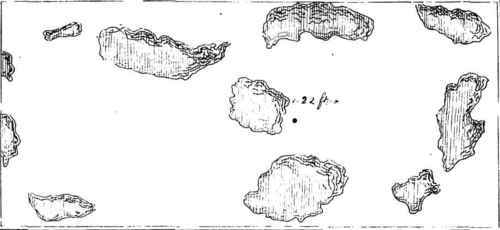
One of these dowagers had the best of the argument, and both of the other women finally gave in to her. She said the room occupied by some good-for-nothing apple tree was space enough for a bit of natural gardening. "Or," she went on, pointing towards an abused wood lot with a knot and a springy spot at the foot of it, "that would be a lovely place to begin one. You can buy plenty of land like that for five, ten or twenty dollars an acre, and with that properly laid out you will have cities of refuge for all the wild plants that are possible out of doors in our climate".
Then she told us how we might cut and grub around the most charmingly natural coppices, making sunny glades and fine grassy spaces, fit for anything, out of such unkempt forest as that, and she stopped the carriage while she drew this rough sketch of her plan on the bottom of a luncheon box. (See illustration accompanying).
"There ! Save every tree, shrub and herbaceous plant that you haven't too much of, and add more at your leisure," cried dowager No. 1. (I could have hugged her for her sound sense of things, and Mrs. Tarryer knew it!) "You will never tire of walking down those ever-changing and always unexpected grass aisles, brushed over occasionally with a scythe, and seeing things grow beautifully wild".
"But how about your apple tree spaces, and what will you do for anything like the water of that spring?" asked dowager No. 2.
"Well, a book of directions would not help one who has no idea of plant society, but one who studies its rules and amenities in many woods would find the drainage of her ice chest spring enough for a hundred of the native orchids I have under the seat".
* Note. - In a private letter Mr. Tarryer wishes me to state that " it was one of the dowagers." - Ed.
"How do you determine the exact shape of those groups of trees and shrubs?"
"Cut and grub to the shape they are in now. For a new design to plant on a fiat surface, toss a child's necklace on the table, or twirl a skipping rope on the floor".
"But wouldn't you need a barbed wire fence or something to keep people from overrunning your beautiful things ?"
"People don't overrun beautiful, but ugly things. Make your plantations really beautiful and the common people will be as choice of them as you are".
This was a rather personal remark, for dowager No. 2, in the time of her first husband, had tried broken bottles set in cement on the top of a stone wall, without effect; but Mrs. Tarryer hastened to suggest that "a hedge fence, such as the boy6 used to snare partridges, or stumps and dead mossy wood might be laid around wild borders and stuffed with woods-mold, while the plants were young, to check unwary trampling; and all such designs should be carefully weeded, and planted in strict accordance with sylvan fashions".
Continue to:


My Books

