


Our Back Yard - II. The "Secondly" Of A Little Lay Sermon
Description
This section is from the book "The American Garden Vol. XI", by L. H. Bailey. Also available from Amazon: American Horticultural Society A to Z Encyclopedia of Garden Plants.
Our Back Yard - II. The "Secondly" Of A Little Lay Sermon
WHEN we first took possession of what is now our garden it did not merit that name except from its great possibilities, for it then had no existence other than so many square feet of real estate, valuable, perhaps, but not beautiful. It was in very nearly the condition which I have described in a former article as that of back yards in general. But to the eye of a gardener it presented a promising field for the exercise of his art. Being on the south side of the house, it was open to the sun and sheltered from the cold north winds, so that it was likely to prove an "early garden." The soil, however, was not so promising, as the whole yard had been "skinned" of its top soil in consequence of some former grading; hence what was left was a stratum of " rotten rock," which was never intended by nature to supply food for shrubs and flowers. At that time our ideas on the subject of gardening were more general than precise, so that we also had to contend with the worst of all difficulties - ignorance.
But as a perfect love cast-eth out fear, so a horticultural enthusiasm overcomes all obstacles, and by patient work from that time to this we have gradually converted the waste place into a small garden which, though by no means perfect, or what, in the light of our constantly rising ideals, we would like it to be, is yet a vast improvement upon the original chaos, and a source of great pleasure to us and our friends. We hold that man to be unworthy of the good gift of a garden, however small, who fails to share its pleasures with his neighbors, and give as freely as he has received. Unnumbered are the bouquets and boutonnieres which have been distributed among our friends and neighbors, and the little garden, like the widow's cruse, is always full.
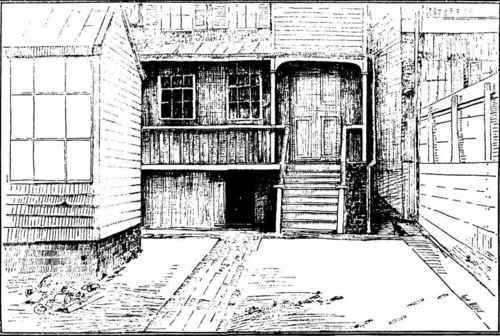
Our Back Yard When We First Took Possession.
We began with the grass, which is the foundation of all gardening in these latitudes. Having smoothed off the ground with a rake, we invested a quarter in a package of "mixed grass seed*" which we sowed evenly all over the parts of the yard destined to constitute our "lawn." The basis of most of these mixtures is Kentucky blue grass, which not only comes up itself, but seems to have a wonderful influence in inducing the grasses to the manor born to come up also, for the fun of choking it out. So, between the Irish and the Know-nothings, we soon had quite a respectable display of green to serve as a setting for our flowers.
Our Back Yard in its Second Summer.
We next pored over florists* catalogues with a pleasure which, alas, we can never know again - the pleasure of anticipation ! It is one of the saddest facts of life that knowledge is bought at the expense of the capacity to enjoy. The flowers which we then saw with the eye of faith, while contemplating the phenomenal representations of the catalogues, we not only have never since beheld with our physical eyes, but we cannot now enjoy its visions, as in our days of trustful ignorance. Yet the mild reality is sufficient to repay all expense and labor, and the honest florist gives you your money's worth, though he also gives carte blanche to his artist.
Our first venture was a dozen roses, which appeared so small when they arrived, all in one little cigar box, that we were discouraged with the prospect. But when planted out and well manured, they soon took heart of grace, and in a year's time they were quite respectable in size. But I would advise the amateur florist to whom money is not an important object to buy well-grown plants in the first place, and save much waiting and uncertainty. We bought in the same manner most of the standard varieties, and now have, in the rose season, quite a fair display. We have found it best not to experiment with novelties, but to leave that to those who have more money and time. There are well-tried sorts enough to provide all reasonable variety, and the inexperienced will save themselves many disappointments if they confine their purchases to such. A Cheshunt Hybrid, a Reine Marie Henriette, a Mi-crophylla and a very profuse-blooming white rose, name unknown, are our climbers, and, aided by honeysuckle, clematis, jessamine, Virginia creeper and several other vines, they serve to quite effectually hide the board fences which mark the limits of our small domain. None of these things, except the roses, cost one cent.
The honeysuckle, clematis and jessamine came from cuttings, which may be had for the asking, and the Virginia creeper from the woods, where all are welcome to help themselves. The beginner will find much pleasure in learning how many beautiful plants he can grow from small pieces stuck into moist sand or even the open ground, and where, as in our case, money is a prime consideration, the number of possible plants will be much increased by these experiments.
As the result of our experience we have come to prefer hardy perennials as far as possible for the use of those who can only devote a limited amount of time to their gardens. The annual vines, in particular, are not so desirable as those which are ready at the first opportunity in spring to "continue business at the old stand."And our old-fashioned columbine, cowslips, and plants of like character, are already making our garden bright before we can stick the spade in the earth to prepare it for the annuals and bedding plants.
Almost ever since we commenced gardening we have made a specialty of chrysanthemums. I believe there is no flower that the amateur can grow which makes such large and satisfactory returns for the money and labor expended. We began with one or two of the old sorts, yellows and whites, and have gradually worked up, as we learned the secrets of their proper cultivation, until now we have 25 or 30 kinds. The part of our garden devoted to them is not more than 7 feet by 25, and yet from this small bed we last season cut bushels of flowers, and at the time of writing (Dec. 1st) there are almost as many left. We first bought of a florist in New York some dozen or more named varieties, and since then we have several times bought seed. Started in the house in the early part of April, and shifted from pot to pot as they grow, we have found that 90 per cent. of our seedlings will bloom the year of planting. In this way we have obtained some beautiful kinds at a very small expense, and derived much pleasure from the surprises which seedlings always have in store for the gardener. We set our large plants in the open ground, in rows, and work between them freely with a hoe about once a week during the continuance of warm weather, watering with a hose whenever needed in the least degree.
About the time of flowering we build over the entire bed an awning or tent of cheap cotton on a framework of light pine sticks, just high enough to walk under, which, in our climate, is ample protection from frost. Chrysanthemums cannot be had in perfection without work, but if you give it they will repay as surely as the coming of November.
Disappointments have come, of course, and moments of discouragement. For some reason, probably the original poverty of the soil, our ever-blooming roses have never done well, neither blooming profusely or handsomely. But we hope next spring to dig out the present earth from their bed and replace it with very rich soil, and shall expect better results.
I have tried in this article to give some hints to those persons who know little about the common facts with which the beginner is confronted when he first attempts to "make things grow." I would have been glad of some such information at the outset of my own career in this line, but what we have learned has been learned by the painful but effective process of butting our heads against the stone walls of natural phenomena. I hope such readers of the Garden as attempt to follow in our path will avoid these obstructions, and at the end of the next floral year have no failures to record.
The pictures with which this article is illustrated are from photographs taken by an amateur friend, and are given, not as illustrations of perfection, but as showing what progress we have made in our fight with ugliness. It is to be understood by the reader that this is an ordinary city back yard, the size being about 30 feet by 70, surrounded by rough board fences. Notwithstanding our efforts to "comprehend all vagrom" cats, an errant Tommy occasionally finds his way into our flower beds, doing damage thereto; but a remorseless rifle, and a steel trap in which we in one night captured six, have thinned the feline population to reasonable proportions. The Garden's sketch of our yard "before treatment," as the patent medicine men have it, is very mild, and shows an imagination rigidly controlled by the love of truth. P. H. Stansbury.
Continue to:


My Books

