


Pollinating Kit (Figs. 3 And 4)
Description
This section is from the book "The American Garden Vol. XI", by L. H. Bailey. Also available from Amazon: American Horticultural Society A to Z Encyclopedia of Garden Plants.
Pollinating Kit (Figs. 3 And 4)
So many little articles are needed in the pollinating of plants that I have found a kit for holding them indispensable. My first outfit was a half-bushel apple basket, which was soon displaced by an oblong peck market basket. Both these had the advantage of the greatest democracy of contents, for bags, strings, pencils, notes, and other trifles, made most promiscuous acquaintanceships. Leaves, sticks and other litter drifted into the medley, and to complete the confusion someone was sure to want the basket the moment I set it down, and all my stock in trade would next be found in the ashpit or under a bench. And when X loaded up again I was sure to omit something, for there were no compartments to suggest a complete outfit. This shortage in my accounts was usually detected too late, both for the experiment and for my patience. I next tried my pockets, but the ar-ticle was always in the wrong pocket, and there was too much of everything else in every pocket, anyhow! So a tin box, with a place for each trifle, finally grew out of my experience. This box is 9 by 12 inches and 3 inches deep, A chest handle is placed in such position on top that the box balances nicely in the hand.
The bottom of the box, which is two inches deep, contains in the upper left-hand corner a large compartment for bags. Adjoining this is one of similar size for labels. The artist, for some reason of his own, has made this compartment into two. Below the bag compartment is a long box for pencils, camel's-hair brushes - which I carry wholly out of respect to instructions in books, for they are of little use - a jack-knife. small scissors, and two or three smaller but very useful trinkets. Two or three little compartments join this, in one of which is a lens - I find a photographer's finder the best lens for this purpose - and in another two or three small vials and boxes, in which I sometimes collect pollen. Along the right-hand side is a compartment for strings, which are cut six inches long, and in the upper corner is a small bottle of alcohol. Into this alcohol I dip my tools as soon as I am done with any pollination, to destroy any pollen grains that may adhere to them, and which would be likely to interfere with a subsequent operation. Finally, behind a spring in the lid is a notebook. I find very small surgeon's scissors the best implement for opening flow-ers. The smallest steel crochet-hook is very useful in hooking out the anthers of many species.
I make a spreader, for applying the pollen, out of a large pin. I cut off the head and flatten the other end. and then insert the large end into a handle. This makes a tiny scalpel, which is worth more for the purpose of applying pollen than any number of camel's-hair brushes. 1 have tried many bags, and several patterns have been manufactured for me, but none suit so well as the common manilla grocer's bags. For most plants the ¼ -lb. bag is suitable. While the bag is still flat, a soft string is run through two of its edges about an inch from the open end, and the string is tied at one of the edges to keep it from falling out. big. 5 explains the method. The bags are dipped into water an instant a few minutes before they are used, so that they will be soft enough to tie snugly about the plant. It is now a pleasure to go a-pollinating.
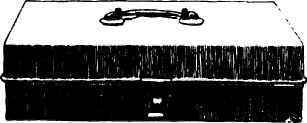
Fig. 3. Pollinating Kit.
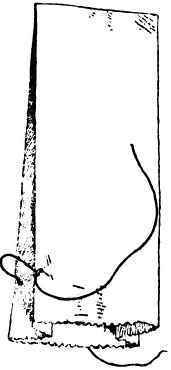
Fig. 5. Pollinating Bag.
Continue to:


My Books

