


Rockeries And Fern-Beds
Description
This section is from the book "The American Garden Vol. XI", by L. H. Bailey. Also available from Amazon: American Horticultural Society A to Z Encyclopedia of Garden Plants.
Rockeries And Fern-Beds
Rockeries And Fern-Beds are desirable additions to any lawn if rightly managed, but I know of no more favorable situation for ferns than the narrow strip of ground between the foundation stones of a house and the channel worn by the drip of water from the eaves (supposing of course that the house be furnished with a wide jut). The advantages gained over other locations consist mainly in perfect drainage, coolness and sufficient moisture, all essential elements in fern culture. Partial shade is also desirable.
The question often arises as to kinds of ferns which will bear transplanting, and the prevailing impression seem to be that only the commoner sorts take kindly to cultivation. To convince all skeptics to the contrary, let me introduce my own collection of growing ferns, which occupy some thirty feet of ground on the east side of my house. Unscientific people, who shiver at the sound of long names, please turn a deaf ear while I present Struthiopteris Germanica for inspection. Tall, handsome and very tropical-looking, is it not, with its vase-like circle of foliage ? This fern is commonly called the ostrich fern; it grows in moist places, often to great height, and is especially beautiful in early summer, before the pinnae have fully straightened, as the segments then are curved like the plume of a veritable ostrich feather. As a good foil to the ostrich fern in point of color, we have the deep-green of Goldie's wood-fern, the king of all the aspidium tribe. Although abundant in certain localities it is by no means common. I know of no fern having richer, heavier foliage ; full grown fronds are often two-and-a-half feet long and one foot wide.
It is considered one of the finest ferns in the Eastern States.
But for real elegance in the fern family we must take off our hats to the osmundas. Can anything be more beautiful than the royal osmunda ? Here are several fine specimens, stately and tall, yet graceful in form and delicate in color ; the fertile racemose panicle at the summit of the fronds adds much to their beauty, and gives the name of "flowering-fern" to this species. Scarcely less attractive, but very different, is the cinnamon fern, Osmunda cinnamomea (Fig. 1). This grows in large bunches; the sterile fronds are clear-cut in outline, of firm texture and rich color ; the fertile fronds are entirely distinct, although coming from the same root-stock ; they are covered with cinnamon-colored sporangia, and when four or five of these tall spikes are encircled by the glossy green of the sterile fronds, the effect of the plant is both unique and beautiful.
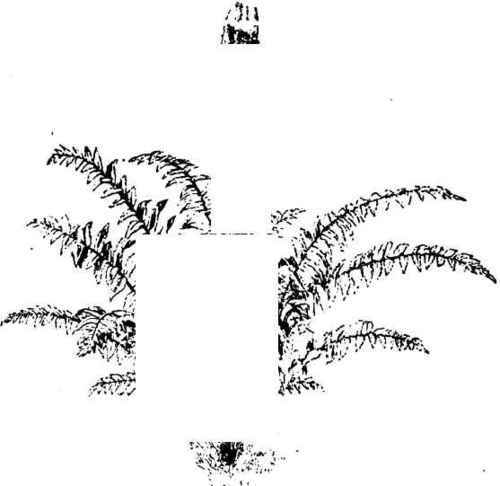
Fig. 1. Osmunda cinnamomea.
Fig. a. Osmunda Claytoniana.
Osmunda Claytoniana (Fig. 2)
Osmunda Claytoniana (Fig. 2), is the least attractive of the three; tall and handsome it surely is, growing somewhat after the manner of the ostrich-fern, but one cannot but feel that somehow nature made a mistake in placing the fertile pinna? in the middle of a sterile frond ; but there they are, dry and brown in the mass of green, giving the plant the appearance of having been smitten with a blight of some sort, and looking not in the least like a special design of Providence.
Adiantum Pedalum
Adiantum Pedalum, an old time favorite, speaks for itself ; every one loves the maiden-hair, and it is not, as many suppose, difficult of culture. Contrasting finely with the delicate foliage of the maiden-hair are the grass-green fronds of Onodea sensibilis. Just why such a coarse-looking fern should receive such a name was puzzling until we learned that the fern wilted almost as soon as picked, and that the segments have a tendency to fold themselves together face to face, hence the name sensitive-fern. The fertile fronds are not very common ; they look like dense clusters of diminutive grapes, are nearly black in color and dry up in winter, but remain standing for a year or two.
Nearly all of the aspidiums are easy of culture, and I have some half dozen or more species ; among them I consider A. acrostiehoides very valuable. (Fig. 3.) It is the smooth glossy fern, improperly called rock-fern. The evergreen wood-fern, A. marginale, is also a good fern, and one to be depended upon to grow under adverse circumstances.
This strip of moss, thickly dotted with pert little ferns, one frond in a place, is none other than Polypodium vulgare (Fig. 4); the fronds are evergreen, smooth, from four to six inches high, and are simply and deeply pin-natifid; indeed one could fancy them all cut with a pair of scissors from a paper pattern.
One of the secrets of fern culture is to simulate natural environments as far as possible. For instance: the polypodium just mentioned was peeled from the top of a rock, where it usually grows in large mats or sheets; therefore I placed flat stones by the side of the house where I wished the fern to grow, dusted them over lightly with leaf-mould, packed the moss and fern upon them, and gave a thorough wetting. Likewise ferns which grow in the crevices of calcareous rocks are easily wedged in between bits of rock and stone; hence my success in naturalizing rare and difficult ferns. That long, slender, lace-like fern which has draped itself so gracefully against the gray building stone is Cyslopteris bulbifera, or bladder-fern ; this is the only fern in my collection which bears tiny bulblets on the underside of the rachis and pinnae ; these bulblets falling off grow rapidly, causing the great abundance of this fern in its natural haunts. At the base of this please notice the bluish-green foliage of Pellaa otropurpurea pushing its way from among the stones. I am proud of this fern, for it is fully naturalized, as this is its third year under cultivation. By the side of this is its sister fern, Pellaa gracilis (Fig. 5), the most fragile fern that grows.
It is much smaller than P. atropurpurea, although similar in form, the recurved edges of the fertile fronds conclusively proving kinship. The foliage is deciduous and of pale green color. The plant is often found hanging like a fringe along the seams of rocks. Eaton tells us that it is rarely secured by collectors, because the root-stock is so hidden in such crevices; all of which goes to prove how little mankind knows of "what woman's wit when put to proof can do." Having seen fine specimens successfully fished out with a hair pin, I would suggest that such articles be added to the outfit of all botanists ! Pellaa gracilis does not always grow in this way. If the sporangia happen to fall on a shelf of moss-covered rock, the following season will find the moss supporting ferns ; the specimens I have are thus embedded, and they are apparently doing as well as the polypodium with like treatment. I have faith to believe that this fragile beauty can be naturalized, although the test is not complete. The curious walking-leaf Camptosorus rkizophyllus grows very well from the root-stock, but does not "walk" from the apex, after the manner of its kind.
Representatives of the spleenwort family complete my collection. Asplenium ebeneum always attracts attention, standing straight as a sentinel, some eighteen inches high and never over two in width ; the stipe is black and shining, the pinnae lanceolate in form, and evergreen. Lift the fronds of some of the taller ferns and you will find the daintiest fern of all, Asplenium trichomona, sometimes called the maiden-hair spleenwort ; this grows in tufts on the shady Side of cliffs, and is wonderfully neat and pretty. A tuft of this is shown in the initial at the head of this essay. Close beside it is another tiny fern, Asplenium ruta-muraria. It bears no resemblance to any other fern and is very rare. Both have taken kindly to cultivation, and are as much at home as if hanging from the side of a limestone cliff. - G. A. Woolson, Vermont.
Continue to:


My Books

