


Weeding And Weeders. Continued
Description
This section is from the book "The American Garden Vol. XI", by L. H. Bailey. Also available from Amazon: American Horticultural Society A to Z Encyclopedia of Garden Plants.
Weeding And Weeders. Continued
Among Mrs. Tarryer's first studies of weedingtools for herself, when people were learning to buy instead of making what they want in this country, she had a bayonet-hoe in its rudimental modern trade form presented to her by a dealer as an imported article, costing 75 cents at retail, without a handle. It had a socket that wouldn't hold a handle securely, no goose-neck, and a blade that would hold neither edge or point. Made of iron or low steel, by clumsy hammer-smiths, it had the air of reversion from a good thing in the hands of generation after generation of mechanics who didn't know or care what they were making it for. Arts are lost when we sequester them from the land they were meant to decorate; as religions change so their own grandmothers wouldn't know them, when transplanted from the soils and seasons they were meant to serve. The make of iron candlesticks, fashioned after one of the seven of the altar, still goes on, but their real use now is in pork-factories. Trade tempted from teaching is to blame for these degradations.
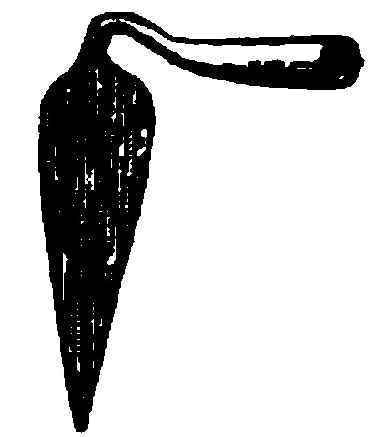
Mrs. Tarryer bothered me a good deal with that bastard bayonet, made so as not to arm the peasantry. In the course of 25 years she stood over as many blacksmiths, keeping the old trade-sample as a model of how not to do it, until what she calls the bayonet -hoe of the re-naissance was elaborated. This was duplicated by the force of one of our great corporations - the same that made John Brown's pikes for him - in considerable numbers. Since that time it has been waiting for wholesale orders ; and meanwhile the country has been filling up with kentledge of the old clumsy patterns, fit to prevent intelligent women or men either from going into the garden - except "as an example to the children".
As an implement of peace the bayonet-hoe must be far older than the bayonet of Bayonne, or than fire-arms, or cross-bows, and as old as any fine implements of warfare, for men never learned to fight weeds or weedy mankind really well till they had beautiful gardens to fight for. This new bayonet-hoe, with its graceful goose-neck, throwing the handle so as to work on the central resistance of the blade, which is but the keenest form in steel of a rigid fore-finger; and furnished with a knob-hilt that is a ball-and-socket joint in the hand, related to the skin of the palm as the pulley is to the belt; is, altogether, when thoroughly wrought in two sizes, the perfection of hand-weeding tools for all work. It is fit for the most delicate touches next to plants in the seed-bed, and for deep digging and uprooting there is nothing that can be applied so effectively and rapidly with so little power.
For the heaviest work, Mrs. Tarryer believes in men to a certain extent. I've seen her pile three or four of her hoes, such as he had never seen before, on the shoulder of a new hired man, meeting his puzzled look by telling him to "go out in the garden, but see that you don't do any mischief till I come." Within a week that man would be explaining to some acquaintance that he could do four times more business in a day with those hoes, among all sorts of crops, than with any tools he ever saw. But we change man's religion if we give him new tools - hence we are very cautious, and keep buying the old things that incline us to hope for some better word than this.
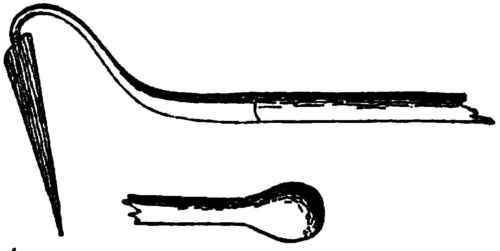
"Come, girls!" Mrs. Tarryer would say some cool morning after breakfast, "it is a good day for Rumex* and Repens!* Take an extra hoe or two along with you for company !" So she would "give the bayonet" to the creeping-roots of the plants mentioned, marching over 12 or 15 acres of garden, in a way said roots would not forget for weeks. Her days of judgment for weeds came often and were followed to extermination.
When Mrs. Tarryer found the self-same bayonet, in effect, that she had. wrought so faithfully by twenty-five years' practice, in Loudon's "Agriculture" or "Gardening," she was delighted. She greatly prefers to have decrepit old book authority on her side, whenever it happens to know enough.
This was Lord Vernon's or the Spanish pattern. That origin would take us among the exquisite Moorish artisans, who inherited the crafts of the Orient, so that we may reasonably presume the mountain green Amytis of Babylon, who would have her garden set up where she could air herself, had nearly as good bayonet hoes as Mrs. Tarryer's. She was as pleased with the finding in Loudon, as by Dr. Warren's showing in " Paradise Found" that' Homer knew the world was round rather better on the average than we do.
Loudon wrote "for his keep," they say, and must have been kept rather short by his publishers and readers, or he would have handed the bayonet-hoe down to us in better working shape. This is one of his ancient emblems, a blasted bud of British handicraft, and the same thing has been repeated in stupid American manufacture - the progeny of Yankee book-worms crossed with the abortive imaginations of mechanics who never had a decent garden.
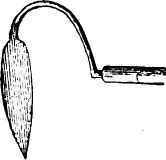
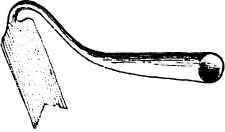
Another of Mrs. Tarryer's recreations appeared in Loudon in this shape seventy-five years ago. It is evidently intended as a plantain weeder, copied and degraded by dim art, working for generations with uncertain hammer and pencil. Mrs. Tarryer hails The American Garden to the revival of these beneficent antiquities. Years ago she had the same conception in far more perfect form for weeding grass-plats and door-yards, and as a lawn-weeder. One time I had forty acres of old pasture under treatment, when it sprang thick with mulleins and the neighbors were laughing at us. But she set me to cutting old hoes down to the above pattern, and one day in May when it rained so it wouldn't do to have creatures out, she borrowed seven umbrellas and packed eight or nine of us off bare-foot and with trousers rolled up to cut those mulleins. The state in which Mrs. Tarryer performed this exploit is reckoned by the census to contain so few "women engaged in agriculture," that no doubt she was the only one counted.
Mrs. Tarryer thinks the next census will find more women in the garden.
Not much can be done about these things till trade and manufactures get clearer views from an indignant public of the art of hand-weeding. Yet we can at least refuse to buy the hoes that have no socket to hold a decent handle.

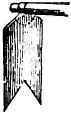
*Sorrel and "grows-through-potatoes grass " - Ed.
Continue to:


My Books

