


Pear. Part 2
Description
This section is from the book "A Dictionary Of Modern Gardening", by George William Johnson, David Landreth. Also available from Amazon: The Winter Harvest Handbook: Year Round Vegetable Production Using Deep Organic Techniques and Unheated Greenhouses.
Pear. Part 2
Haddington
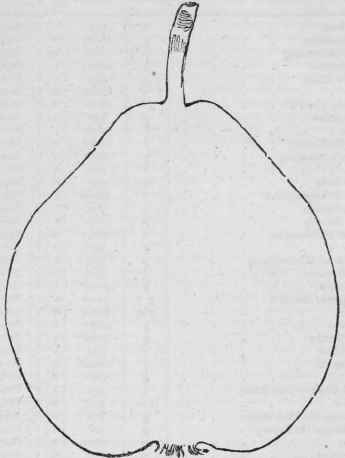
(Smith's.) (Fig. 110.) We have by the merest chance this excellent addition to our stock of winter pears. Mr. J. B. Smith, when on his farm near Haddington, Philadelphia County, in 1828, reared from the seed of the pound pear, a number of young plants for stocks. This one accidentally remained unworked, and on Mr. Smith's removal to the city, was brought by him and planted in his garden, where it now stands, singularly erect, and with few horizontal branches. It comes into use in December, and keeps through winter; the skin is green, when ripe slightly yellow on the sunny side, and marked by minute russet dots or specks. The texture of the fruit varies; some are quite melting, others incline to break - it never cracks, bears abundantly, and we conceive it quite an acquisition to our winter pears.
Fig. 110.
Pennsylvania
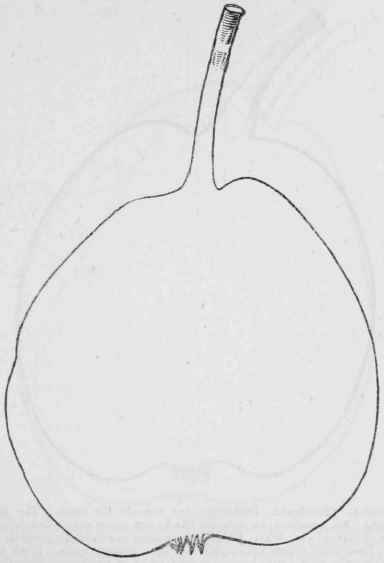
(Smith's.) (Fig. 111. This, so named by the Pennsylvania Horticultural Society, is a seedling on the grounds of Mr. J. B. Smith, Philadelphia. The original tree is 35 to 40 feet high, pyramidal in form, of robust habit, retaining its foliage unusually late. Its origin and age are unknown, but this and the Moyamensing (subsequently described) standing in the same garden, have recently been recognized by an aged lady, who knew these identical trees when a child. The fruit in outline and general appearance somewhat resembles the old Beurre - prevailing colour, brownish yellow, occasionally speckled and burnished with brighter yellow on the upper portion, the lower or blossom end presenting a uniform dull brown or russet hue, the sunny side dotted with red. Stem deep brown an inch and a quarter long, standing nearly erect, planted on a full crown; in some specimens one shoulder more elevated than the other. Calyx small, in a shallow basin. Flesh yellowish white, rather coarse grained, and somewhat gritty; flavour notunlike the butter.
Ripe, 10th August to middle September. It is a fine bearer, never cracks, and may be classed among the good American pears.
Fig. 111. - (P. 432).
Moyamensing
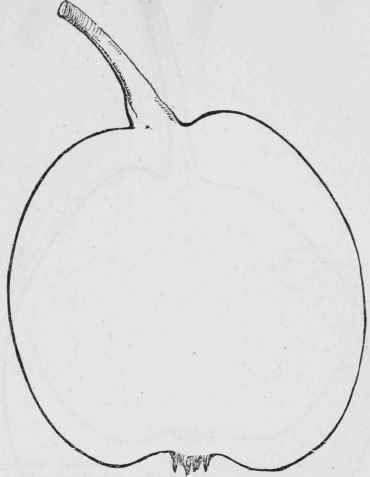
{Smith's Early Butter.) (Fig. 112.) This is supposed to be a native. It stands in the garden of Mr. J. B. Smith, Philadelphia, is 28 thirty feet high, open in growth, and uniformly sheds its leaves early in August. The fruit vary in shape - some are roundish, others obovate: colour, a uniform light yellow. Stem an inch long, in some specimens set in a shallow basin, in others rising from the crown with a fleshy and enlarged base. Calyx rather prominent, in a shallow plaited cup. Ripe from middle July to close of August. The texture is buttery, so much like a Beurre as to have received the above synonym. It is a desirable variety.
Fig. 112. - (P. 433).
Continue to:


My Books

