


Spring Gardening At Birmingham. Continued
Description
This section is from the book "The Gardener V3", by William Thomson. Also available from Amazon: The New Organic Grower: A Master's Manual of Tools and Techniques for the Home and Market Gardener.
Spring Gardening At Birmingham. Continued
The straight lines running from back to front, forming the divisions of this border into oblong beds, are composed of dwarf Spruce Firs, kept clipped to a minimum height of 12 inches. The outline of the angular oblong panel within each division is formed also of a double row of Scotch Firs; these are used only at the time of planting out for the spring display, and are removed when the summer bedding plants are placed out.
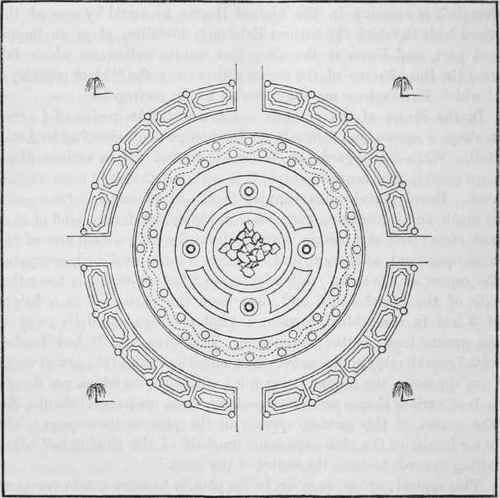
The spring display of these beds was arranged thus: The space between the double row of dwarf Firs was filled with double red Daisies, with a line of the variegated Arabis mollis between the Daisies and Firs; outside the inner panel formed by the Firs, and all round it, was a line of Stachys lanata, and at each angle a patch of Aubrietia purpurea in the form of the segment of a circle. This arrangement was carried through the whole series of beds forming the outside circle. In the centres of the beds the arrangement alternated with the next bed; either it was a centre of the pink Silene pendula mingled with double crimson Tulips, or a centre of blue Forget-me-not mingled with the pretty rose-flaked Silver Standard Tulip. Next the broad circular gravel-walk was an edging of turf, about 12 inches in breadth. It was a happy thought of Mr Quilter's to throw up this raised circular border: the area of this garden is so large that it requires some such arrangement to show off the fine effect of the masses of colour found here; and no one can give an idea of the splendour of the scene but those who have inspected it.
Turning now to the centre of this garden, the writer comes to speak of a display almost unparalleled in the history of spring gardening. The outside scroll-bed is on a level with the circular walk, and, with the sunken garden in the centre, may be said to be inlaid in turf. Next the scroll-bed, on the inside, is a sharp fall of some 5 feet, in the form of a turfy bank; then come four circular beds, each surrounding a pedestal supporting a vase, and four beds between them in the form of sections of a circular line. A fountain, rather below the level of this sunken garden, forms the centre, composed of "slag" - i.e., the bluish-tinted rock-like refuse from the glass-works; a low stone basin contains the water. The double line round the fountain in the diagram represents a border; next the basin was a line of the common Fern of the woods; then, inside, a circle of Spruce Fir; then Wallflowers, edged with a circular line of showy gold-laced Polyanthuses. Among the Wallflowers, Tulips were planted thus: at the back a row of double crimson, the remainder with the double yellow. The pedestals in the four small circular beds were also formed of "slag." The vases had been filled with Hyacinths, but these had been removed, and their place supplied with Centaurea candidissima.
The beds at the foot of each pedestal were filled with Echeveria secunda. The other four beds were filled with Silene pendula as a carpet. From two of them rose a kind of canopy formed of the Silver Standard early single Tulip; from two others, the showy single Duchesse de Parma, red, edged with gold.
But the feature of the garden was the scroll-bed now about to be described. This bed is above 90 yards in length, by 5 feet in width. The serpentine line was formed of a deep-coloured double crimson Daisy; while the rounded angles or groundwork of the bed were filled with the double white Daisy. On either side of the winding line of crimson Daisy was one of Echeveria secunda. The small circles on the path-side, as seen in the plan, were formed of a small clump of the dark-foliaged Ajuga reptans, encircled by the pink double Daisy, which was again encircled with Viola cornuta. On the fountain-side the Ajuga was still employed as a centre to the circles, but surrounded by Aubrieta purpurea, encircled by the variegated foliaged double Daisy. This arrangement appeared to be perfect, and the mass of colouring very fine indeed. Mr Quilter stated that it took seven thousand Daisies to plant this bed alone. Looking at this display from either side of the garden on entering, a kind of irregular but large mass of colouring was perceptible; but as the visitor approached it, the exquisite arrangement became quite clear, and the mass of blended colours rose up, as it were, to meet the eye.
Of all the manifold aspects of the gardens here, this scroll-bed was the most striking, and a sight of it would have amply repaid a journey from London.
In a flower-garden that exhausts above a quarter of a million of plants at bedding-out time, there must, of necessity, be many details that it is impossible to sketch within the compass of a paper of this extent. It may be stated, however, that there is a broad border under the wall on each side of this garden, some 10 feet in width, formed into diamond-shaped panels by the use of the dwarf Spruce Fir. On two sides of the garden these panels were filled alternately with blue, yellow, white, and purple Pansies; and on the two other sides with blue and white Forget-me-not and Silene pendula, used in distinct masses of colour. The angles, back and front, were filled with Cerastium tomentosum, which comes into flower almost at the same time as the spring-blooming plants; and when the occupants of the beds are changed, it is simply necessary to clip the Cerastium with a pair of shears, and then it likewise does good service as a foliaged plant the summer through.
It would tax the ablest pen to do justice to these grounds and their extensive floral decorations. The horticultural world should know how much is being done in the somewhat uncongenial neighbourhood of Birmingham to create and foster a love for flowers, and the incidents of horticulture there; and it should also know that the most gratifying results, both in a professional and a social point of view, have sprung from what has been so well attempted. The somewhat cynical American essayist who wrote of the English people that "they are proud and private, and, even if disposed to recreation, will avoid an open garden," could not have visited the Aston Lower Grounds. To these gardens come visitors of high and low degrees. In the presence of flowers and their intimate surroundings, the distinctions of caste seem to be (temporarily at least) laid aside. They still teach the great lesson drawn from their simple beauty by that wondrous Teacher of old, "that Solomon in all his glory was not arrayed like one of these." R D.
Continue to:


My Books

