


311. A Rustic Seat
Description
This section is from the book "The Villa Gardener", by J. C. Loudon. Also available from Amazon: The Villa Gardener.
311. A Rustic Seat
From q in fig, 119. p. 207., where the walk emerges from the tunnel, it gradually rises till we arrive at the seat r. From this seat, which may be a rustic thatched structure, in the manner of fig, 123., with a wall behind, and open arches in front supported on rustic pillars, a good view of the entrance front of the house is obtained, which will have a somewhat striking effect upon a stranger, his last view of it having been the very opposite side, viz. the conservatory front. The construction of this seat is as follows: - The whole of the ground on which it stands, being dug out to the depth of 2 ft., is filled in, to within 6 in. of the surface, with concrete; or with chalk and flints, or gravel, rammed hard, and finished with a level surface. On this are raised the bases of the rustic pillars which support the roof, which bases should each consist of a single stone; or, if it is wished to be economical, of brickwork, which will reach as high as the intended surface of the floor, and be there covered with a square or an octagonal paving-tile. On these plinths the rustic columns are placed, and connected temporarily at top by strips of deal nailed to their sides.
The columns, or props, for the back part of the structure, will be placed upon projecting plinths, from one continued plinth: because they are not intended to be seen on the inside, and to appear detached only an inch or two from the wall on the outside. Standards must now be raised, so as to form the skeleton for the solid part of the back wall; and this skeleton must first be covered with thin boards on both sides. This being done, the columns all round the structure are to have caps placed on them, consisting of squared blocks of wood, somewhat longer than the nine-inch tile which formed the plinth below, but of the same width. On these, skeleton arches are to be constructed, and afterwards a skeleton roof, The roof, on the inside, is to be clothed with thin boards, so as to form the interior of a cone; and on the outside with laths, so as to render the exterior of the same shape. The next step is to clothe the exterior of the cone with reeds or thatch, as in the figure. The interior being now secured from rain, the floor may be paved with pebbles, or with sections of the trunks of trees placed endwise, or with brick-bats placed on end; and the interior of the back wall may be covered with strips of wood, of such kinds as have a thin bark, such as hazel, birch, etc, disposed as in the figure.
The exterior of this wall may be clothed with rough bark, such as that of the oak, covered with lichens, moss, etc. The soffits of the arches should also be covered with strips of smooth-barked trees, with the bark on; as should the whole of the interior of the cone, which forms the ceiling. There remains only to fix the seat, which is a simple bench, attached to the wall behind, and with supports in front.
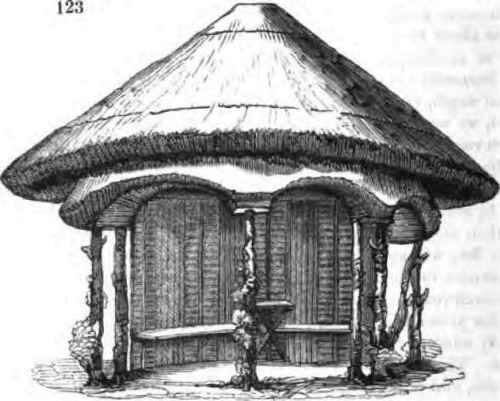
Fig. 124. is another design for a rustic seat of the same general character, but on a smaller scale, and more elaborately finished. The lower part of the bonnet roof, instead of being of thatch, is of strips of wood with the bark on, closely joined, so as to exclude rain. The seat is also more elaborately finished.
Continue to:


My Books

