


364. Staking And Protecting Single Trees In Paddocks
Description
This section is from the book "The Villa Gardener", by J. C. Loudon. Also available from Amazon: The Villa Gardener.
364. Staking And Protecting Single Trees In Paddocks
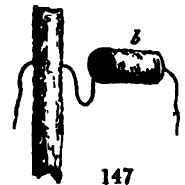
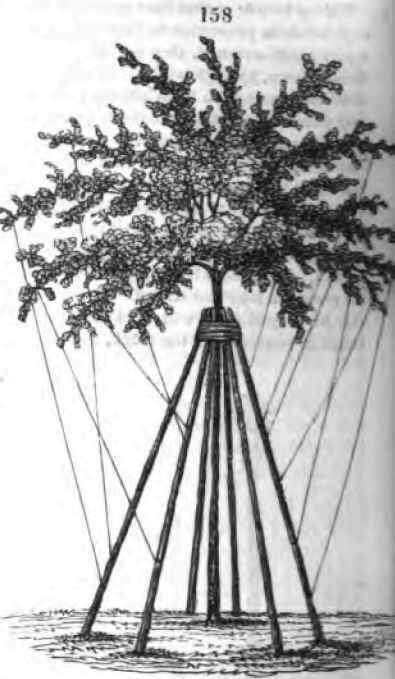
Plants should be selected which have clear items, at least 6 ft. in height: they should he planted on little hillocks, if the ground is at all damp; and staked and protected from the rubbing of the cow. One of the best modes of doing this is that invented by Charles Lawrence, Esq., and explained in figs. 147. to 149. The advantages which this guard has over all others, Mr. Lawrence finds to be, "free motion to the tree, without producing any friction on the bark; perfect security against the attacks of cattle; durability, cheapness, and neatness in appearance." Those guards which confine the tree are objectionable from preventing the motion of its stem, which is essential to its health and growth; and those which stand at a distance from the tree, consisting of three or four posts connected by horizontal spars, are very injurious to the bark in high winds, and are, besides, very expensive and unsightly. The following are Mr. Lawrence's directions for preparing and putting up his tree-guard: Mr. Lawrence's tree-guard against horned cattle. - "Procure stakes of ash or larch, or, in default of these, of any other straight-growing tree, when thinning young plantations, or catting down coppice.
These stakes should be 6 ft. in length, or more if requisite, and about 3 in. in diameter at the thickest end; and they should have holes drilled through them at the top and bottom, about 1 ft. from each end. (Jet a similar hole drilled 8 or 3 inches up the centre of a stake, and then saw off the length which has had the hole drilled through it, and which will give a piece that, when the string or wire is drawn through it, will resemble b in fig. 147. Bepeat the operation till as many pieces are drilled and sawn off as may be wanted. Pass a strong piece of copper, or Rowland's metallic wire, or thick tarred string, through one stake by the hole at the top, and then through one of the 2-inch pieces, then through another stake, and so on, separating each stake at top and bottom by one of the 3-inch pieces of wood, until you have enough to surround your tree loosely, leaving plenty of space for growth. When this is done, the appearance of the guard, before being put an, will be as in fig. 148. Place the guard thus formed round the tree, and fasten the ends of the wire or string.
The guard is much the same as the cradle put round the neck of a blistered horse, to prevent his gnawing the irritated part The ends of the stakes merely rest on the ground, and they should be cat quite flat at the bottom, to prevent their sticking in it At the upper end, they should have a sharp slanting cut with a bill-hook, to throw off the rain. The motion of the tree will not be in any degree impeded; and the bark cannot be injured, let the wind blow as it may, for the guard moves freely with the tree in every direction. If a tree is growing rapidly, it will want room before the guard requires renewing; in which case it is only necessary to untie the string or wire at the top and bottom, lengthen the string or wire by tying a piece to it, and introduce an extra rod, and two extra separating pieces. As a principal feature in this guard is that the tree is left quite at liberty to be blown about by the wind in every direction, of course it does not obviate the necessity of staking a newly planted tree until it becomes fairly rooted."
"I can vouch," says Mr. Lawrence, "for this guard affording perfect protection against cattle; for I had two cows, the most determined barkers of trees I ever met with, in a paddock in which there were several single trees. They had, sooner or later, contrived to get at my trees, and ruin them; and I was about to fatten them off, and condemn them to death tor their offences, when I hit upon the mode of protection Just described. My men and myself were curious to see the Impression that would be made on the cows by the new




Continue to:


My Books

