


An Interesting Arad. Anthurium
Description
This section is from the book "The Gardener's Monthly And Horticulturist V25", by Thomas Meehan. See also: Four-Season Harvest: Organic Vegetables from Your Home Garden All Year Long.
An Interesting Arad. Anthurium
In our last we gave a sketch of a plant of the Arum family which climbed trees and walls. We now give, in contrast, one which does not climb at all - one from Central America, introduced by Mr. Wm. Bull, Anthur-ium insigne. It will be observed that while in the former plant the leaves were scattered along a slender stem, so that there may, perhaps, be but ten leaves along a distance of ten feet, we have here the ten leaves all from one central crown. We often see this varying mode of growth on one tree. For instance, on the pear tree or the larch tree, there are long growing shoots and there are spurs. There will be quite as many leaves from a spur in one season as from the long shoot, and we learn that a spur is nothing more than a long shoot which has become so very much coiled up in its spiral growth as to lose its elongated character. What occurs on a single plant, in the instance cited, becomes a distinctive character in other genera or species of plants. At any rate, the manner of growth of this Aroid is precisely that of a spur in a pear tree or larch.
There might seem no reason why it should not elongate and have leaves along a scattered stem, as in the Pothos, noted last month, when it would probably form another species of Anthurium, or possibly change so much with that variation, in other respects, as to be regarded as a new genus.
We do know - at least gardeners know - why a pear tree bears spurs instead of branches; but no one seems to have been able to tell why such a plant as this should exist as a spur and another have the longitudinal character. But the fact that we can get a glimpse of the law in the pear or larch shows that there is no reason why we may not some day get to know all about it in such cases as these; and these considerations give great encouragement to those who believe they may some day be able not merely to give good guesses as to a belief that species and genera have been evolved out of one another, but actually to show how the species are made, and possibly make them to order.
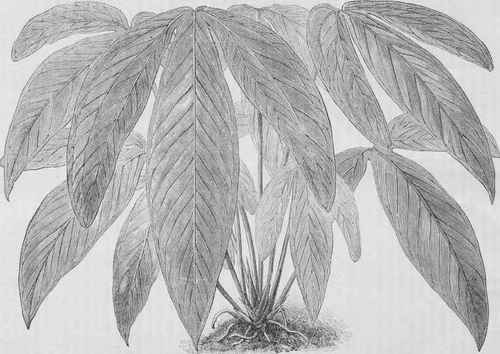
Anthurium insigne.
Mr. Bull says this plant is a real beauty for the cultivator. It is, he says, a noble and striking Or-ontiad, imported from the United States of Colombia. The leaves have terete petioles, which are slightly sheathing at the base. The leaf-blade is three-lobed, deflexed at first, afterwards elevated, the middle lobe lanceolate, and the two lateral lobes semi-ovate, being most developed on their exterior edge; these lateral lobes have from three to five longitudinal ribs, and the central one is pin-nately veined, with a connecting veinlet running about half an inch within the margin. The young leaves have a bronzy tinge before taking on the full green of the mature foliage. It is a very striking plant, and one which should be found in all collections of choice novelties. This was one of the new plants with which Mr. B. gained the first prize at the International Horticultural Exhibition, held at Ghent in 1878, and the first prize at the Great Show of the Royal Horticultural Society, held at Kensington in 1880.
Continue to:


My Books

