


Double Flowers
Description
This section is from the book "The Gardener's Monthly And Horticulturist V25", by Thomas Meehan. See also: Four-Season Harvest: Organic Vegetables from Your Home Garden All Year Long.
Double Flowers
In order to obtain double flowers, it has been thought advisable to make use of the pollen from double flowers, where it is possible to obtain it, and to apply it to the stigma of single flowers from which it is desired to procure double-flowered seedlings. M. Lemoine, desirous of experimenting with lilacs, found that the only double-flowered lilac then known had no stamens, and consequently no pollen. He therefore decided to reverse the process, and to fertilize the stigmas of certain double-flowered lilacs with the pollen from some of the best single varieties. The experiment was so far a success, that out of forty seedlings thirty at least yielded semi-double or double-flowers, one of them being very remarkable for its beauty. - Florist.
In some remarks on the Australian acroclinium, it was noted that what we popularly call a double flower may mean many distinct things. The most common manner of doubling is by the reversion of stamens to petals, though according to a strange notion recently started by Mr. Grant Allen, an English writer, we should say "advance of stamens to petals." The accepted doctrine is, however, that all the parts of a flower have advanced from leaves. A leaf changes to a bract, a bract to calyx leaves, the sepals of the calyx to petals, the petals to stamens and the stamens to carpels. At least this is the successive order of development from the typical primary leaf. We have here an opportunity of giving an illustration of a Double Begonia, a new class of greenhouse flowers, which has attracted considerable attention in Europe. In this case the doubling appears to have been brought about by the retrogression of the stamens to petals. There are now several varieties of Double Begonias. This one is called "Hofgartner Vetter,' and was introduced by Haage & Schmidt, of Erfurt.
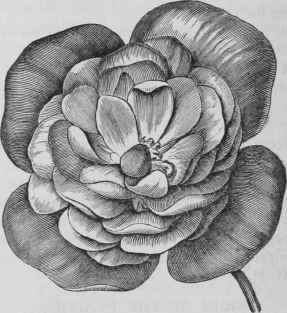
Double Begonia, "Hofgartner Vetter".
Continue to:


My Books

