


Hybrids
Description
This section is from the book "The Gardener's Monthly And Horticulturist V25", by Thomas Meehan. See also: Four-Season Harvest: Organic Vegetables from Your Home Garden All Year Long.
Hybrids
Just what is a species no one can answer. Botanists have some idea what they mean by the term, but no one can define it to another's satisfaction. Neither genus nor species seem to have any place in nature. There seems to have been a provision for continual variation and for continual destruction. New forms are born, old forms decay. When the older forms die, there is a gap in the progeny, and the extremes seem unlike each other. The measure of this unlikeness gives us the idea of the genus or species. The greatest measure of unlikeness forms the genus, the less the species; still less, the variety or race, and the lowest measure of difference distinguishes the individual. This is about all there is in it. There is no exact line between either, still the degrees exist. There are genera, species and varieties, though people may not agree as to where any one begins or ends.
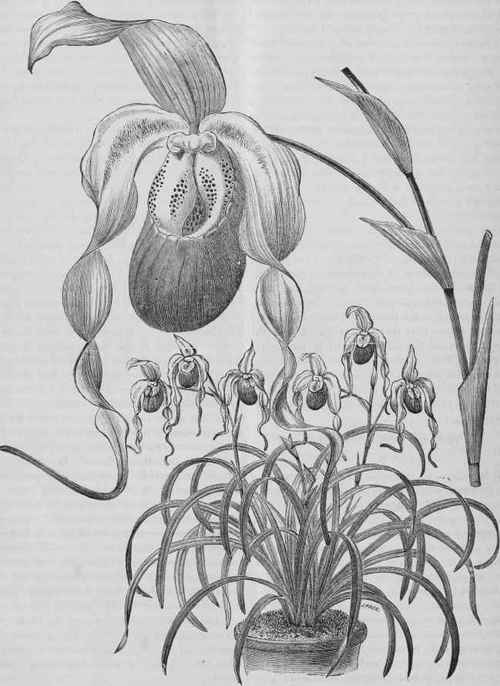
Cypripedium albo-purpureum.
In former times tests were applied to define the differences. Thus, it was assumed that no " distinct " genera or species could hybridize. Although it was found some could, it was then assumed they would be "mules," or unproductive. But now this position has to be abandoned; for though it is still true that many closely allied genera or species will not cross, others, even more distantly related, will, and not only this, but the progeny are often more fertile than the original parents. Tests of species, like tests for witchcraft, are of no value now. The beautiful lady's slipper here illustrated is a good illustration of fertility in a hybrid. Some years ago the foreman of Messrs. Veitch raised a hybrid between two distinct species, which was named Cypripedium Dominii. Pollen was taken from this hybrid and used on another species, C. Schlimii, and this is the product. It is a hybrid in the second generation, and still productive. It has departed so widely from the original parent that, if found in nature, no botanist would hesitate to regard it as a good species.
And there is no reason why they should not occur in nature. These plants are often unable to use their own pollen. Generally it has to be brought from other flowers. Sometimes it may be brought from a distinct form or species; and if the seeds following such pollinization get a chance to grow, and the plants again to make seed and spread, just such a new "species" must come as would be by such an operation as here noted by Veitch.
Aside from this bit of illustrative natural history, the plant has charms for flower lovers. We cannot do better under this head than quote what the introducers tell us about it:
"The flower is even a good deal larger than that of the lovely C. Sedeni. It is whitish with purplish (according to English ideas of color, pinkish) on the borders of the lip with many spots of the same color under it. The spots on the in-flexed lateral lobes which nearly cover the mouth of the sack, are darker and make a nice impression, since these lobes are ivory-white. The sepals have a slight purplish (pinkish) tinge on their borders. The petals are totally purplish (pinkish), and twisted, hanging down and exceeding much the length of the lip. The staminode is light purplish (pinkish), and adorned on each side with many bristles."
Continue to:


My Books

