


The Forking Of Ferns
Description
This section is from the book "The Gardener's Monthly And Horticulturist V25", by Thomas Meehan. See also: Four-Season Harvest: Organic Vegetables from Your Home Garden All Year Long.
The Forking Of Ferns
Botanical periodicals often have notes from correspondents about the forking of fronds in ferns, a feature not found in the normal condition. There are very few species which do not at some time or another give illustrations of their power to fork; but so far as we know, no attempt has been made to show under what morphological law these departures are brought about. Horticulturists, however, have rendered botanical science great service by showing that these singular variations in ferns can be reproduced by spores.
A number of crested or divided forms of ferns are under culture, and one at least, Nephrodium molle. gives its crested form in great numbers from spores. It is not so very long ago that people were discussing how to distinguish a species from a mere variety, and the power of reproduction from seed or spores would then have been denied to a mere variation. Now we find that every variation comes under the laws of heredity, and the fact has been of great value to those who believe that species have been evolved from some prior form. A variety is in fact but an incipient species.
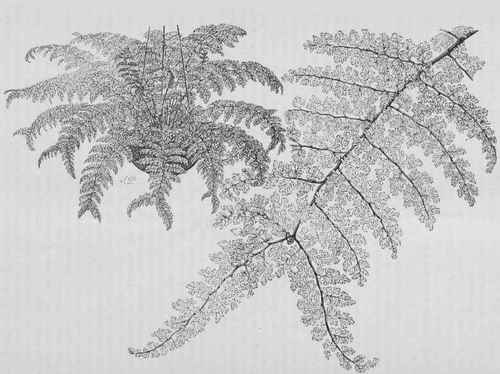
Lastrea Richardii Multifida.
Aside from the botanical interest of these departures from the normal condition, many of them are of great beauty and horticultural value. Here is a crested form of Lastrea Richardii, introduced by Messrs. Veitch, of Chelsea, near London, who give the following account of it:
" A beautiful crested Fern for warm conservatory and intermediate house, sent to us by Charles Moore, Esq., of the Botanic Garden, Sydney, N. S. W.
" Mr. Thomas Moore, the eminent authority on Ferns, in his notice of this new variety in the Gardener's Chronicle for January 22, 1881, writes:
' The typical form of this fern is a New Caledonian plant. In the variety now under notice, which is one of the handsomest of all known ferns, the fronds differ in having their apex and the apices of the pinnae multifidly cut into numerous narrow-pointed, spreading, finger-like lobes. The plant has fronds three feet high, including the stipes, which are a foot long, numerously developed from a short decumbent caudex. The pinnae are upwards of 4 inches long in the broadest part, and terminate in a densely fingered tuft of about fifty long, narrow, acute divisions, the apex of the frond dividing into two or more branches consisting of about seventy of these small finger-like Segments. Its bright green color, its small pinnules, and the bold crested apices with their numerous narrow divisions, give this plant a singularly elegant character, and mark it out as a very ornamental useful fern for the decoration of the hothouse.'"
Continue to:


My Books

