


Anthurium Splendidum
Description
This section is from the book "The Gardener's Monthly And Horticulturist V27", by Thomas Meehan. See also: Four-Season Harvest: Organic Vegetables from Your Home Garden All Year Long.
Anthurium Splendidum
It is said that Alexander wept after he had conquered the whole world, because there were no more nations left to conquer. Those who are marching out to conquer nature, and to become possessed of a knowledge of all her secret ways, are not likely to imitate Alexander very soon, for, look where we may, we see problems in vegetable life that none have ever yet conquered. Plants of the Arum family, to which this beautiful plant belongs, are among this mperturbable set. Some have white spots or other peculiar markings on the leaves, but no one knows why. We have some sort of an impression that it is for the good of the individual, the good of its race, or for the general good of the whole creation; but in what particular respect one with a peculiar marking is of more good to itself or another, than one with some other marking, nobody knows as yet. Here is a plant with leaves, as if covered with blisters. We know that poor humanity is often under the necessity of being blistered from head to foot; but what a plant wants with blisters is a profound mystery.
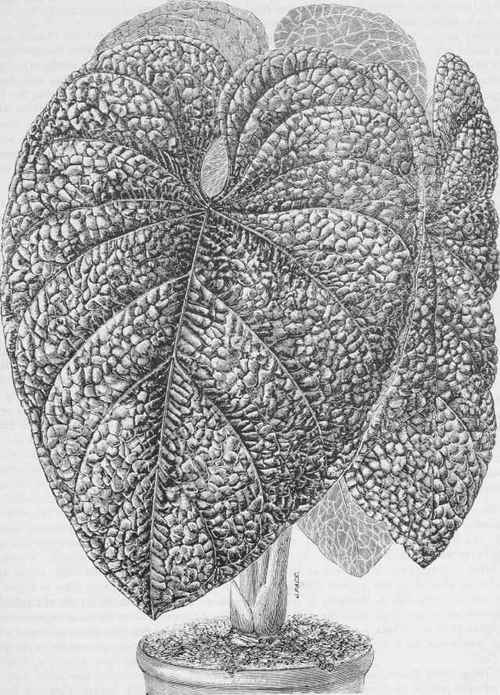
Anthurium splendidum
To our mind it often seems that we are on the wrong track when we try to look for an element of selfishness in every act of life. We sometimes think that plants were made pretty, not for mere attractiveness to insects and other similar selfish ends, but solely to be attractive to those capable of enjoying loveliness. As the poet says, beauty is its own excuse for being; and if this be so we have a very good reason for the blistery surface here. It gives a remarkable and unique character to a leaf that might otherwise be unattractive. Mr. Bull, its introducer, must be excused for the enthusiasm he displays in telling us about it. He says : "It is a strikingly beautiful stove Aroid, imported from South America. It is quite distinct from anything yet in cultivation, and a plant which cannot fail to become universally admired, the surface of the leaves being remarkably peculiar. It has a short, thick caudex, from which spring up the cordate leaves, which have an open sinus, the lobes meeting behind. The course of the nerves is marked by a broadish band of deep lustrous velvety green, the intervening spaces of about equal width being in striking contrast of a pale yellowish green.
The leaf surface is scabrous, and the portions between the ribs strongly bullate as if raised in papillose blisters. The veins on the under surface are angular, with tooth-like projections at intervals, while the whole under surface is punctate with small pallid dots. This will be the great acquisition of the season." (See cut).
Continue to:


My Books

