


Communications. Cactuses
Description
This section is from the book "The Gardener's Monthly And Horticulturist V27", by Thomas Meehan. See also: Four-Season Harvest: Organic Vegetables from Your Home Garden All Year Long.
Communications. Cactuses
It is astonishing what an interest the New Orleans Exhibition has awakened in Cacti.
True enough, they only need to be seen to be admired, and yet the majorityof florists cannot bear them - perhaps, because there is no money in them.
I have a collection of about 400 varieties, mostly small plants, but good bloomers; and even when not in bloom they are always interesting to me. To watch the plants grow, develop their many colored spines, form their buds, expand their beautiful flowers and bring forth their brilliant seed-pods, is to me just as fascinating as to look over a collection of valuable paintings.
When I say florists can't bear them I must except our friend Mr. John Thorpe, who in answer to that imputation writes me as follows : " You are mistaken when you say I hate Cacti; I love them, but in this greed to live there is no opportunity to make Cacti what they will be in twenty-five years. When I tell you that two of my most intimate friends are Pfersdorff of Paris, a man that has actually slept with a Turcshead for his pillow, and Mr. Peacock, of Hammersmith, London, who has had Cereus cylindricus for a bed-fellow, you will not say your friend John Thorpe hates Cacti".
Mr. Thorpe, by the way, has probably the finest Pilocereus senilis in this country. It stands forty-six inches high.
Although for some years I have been supplying leading European houses with rare Cacti, yet I found it almost impossible to get anything like a complete collection for my private use. So at last I have concluded to send to Europe for specimens of every variety catalogued there, which amounts to nearly nine hundred. It is probably about the best way to get them correctly named, which is a very important item. I have had much trouble in this respect, with some thirty correspondents in Mexico and out West. Ask them for Echinocac-tus Sileri, Astrophytum myriostigma, or the Red Night-blooming Cereus, and they answer: "Oh, yes, we have them." When at last you pay ten dollars expressage on a box of samples, you get some Opuntias or a Cereus Peruvianus.
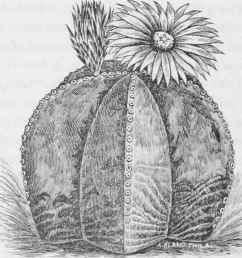
Astrophytum myriostigma.
Many Cacti may well be grown for their beauty of form and spines; for instance, Echinocactus Sileri, Whipplei, viridescens, etc. I think one of the handsomest is E. Ottonis; the flower also is splendid although not fragrant.
Cereus, are my favorites, especially the night-bloomers. I have a C. nycticaulis, raised from a three-inch cutting three years ago, that to this date (July 6th) has opened sixteen flowers this season and has yet twenty-one buds to open. Until this year 1 kept it growing to one stem, in a 6-inch pot and trained it along the roof of my small greenhouse, where it received plenty of sunlight during winter. It made a growth of fifteen feet in two seasons. I have about ten other varieties of night-bloomers, but I find but little variation in the flowers, except as to size and perfume. The true red bloomer, Cereus Schmidti, has not bloomed for me yet, neither has the variety sent to me from Mexico as a red night-bloomer; (three Mexicans swear to it) and of which I do not know the name.
The Astrophytum myriostigma, called in Europe "Bonnet d'evêque," (Bishop's hood) is a very interesting Cactus, being, I believe, the only one without spines. I don't see how Aloe longiaristata could ever have been mistaken for it.
Continue to:


My Books

