


July, 1885. Number 319. Flower Garden And Pleasure Ground. Seasonable Hints
Description
This section is from the book "The Gardener's Monthly And Horticulturist V27", by Thomas Meehan. See also: Four-Season Harvest: Organic Vegetables from Your Home Garden All Year Long.
July, 1885. Number 319. Flower Garden And Pleasure Ground. Seasonable Hints
The past autumn and spring were rather favorable transplanting seasons, but under the best conditions some extra care should be given the first season. The time is coming when transplanted trees of the past fall and spring will suffer more than during any other part of the season. If they show a vigorous growth of young wood no danger need be apprehended, as it indicates that the roots are active, and can supply all the moisture the foliage calls for; but if no growth has been made, no roots have been formed, and the leaves are living for the most part on the sap in the wood and bark; and hot, drying weather will tell with injurious effect on such trees. This is generally first shown by the peeling off of the bark on the southwestern side of the tree, - the most drying aspect; and where such exhaustion appears probable, much relief may be afforded by cutting back some of the branches, syringing with water occasionally, shading the trees where practicable, or wrapping the trunk in hay-bands or shading the southwest with boughs or boards.
In most kinds of soil the keeping the surface loose, by hoeing and raking in dry weather, will be an excellent method of keeping the main body cool and moist, - admitting the air, which is a good non-conductor. In soils, however, which are deficient in loam, and in which sand prevails to a great extent, frequent stirrings have a drying tendency, and a mulching of short grass, or decaying vegetable matter of any kind will be found very useful around transplanted trees, shrubs and other things.
The Gladiolus has become one of our most popular summer flowers. Those who have collections of them arrange the varieties very tastefully according to their colors. Take a list of colors as they flower, so as to arrange them properly next year. We give the same advice for Petunias, Verbenas and Geraniums. The various shades of colors of these varieties, properly arranged, make beds peculiarly pleasing. This is one of the arts of modern flower-gardening, to arrange flowers properly according to shades of color.
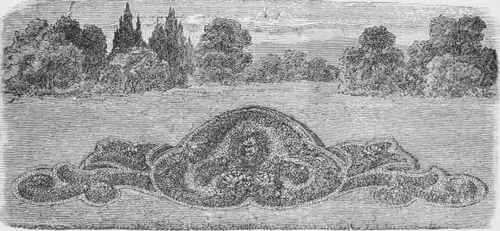
This is the best season of the year for watching the effects of various plants in the now popular plan of carpet bedding, and then arrange the plants as well as the beds themselves for next year. Such beds are very effective when placed in contrast with more natural features. We give on the following page a sketch of one in a park in Germany, taken from the German Gardeners' Magazine, which will give some idea to those who have not seen them, how these beds are made.
We have so much greater variety to choose from that will succeed in our climate, that we ought to have prettier beds than they. Some things, however, like Lobelias, prefer their cool to our warm climate, and we are without a first-class blue adapted to carpet bedding.
The lawns, walks and flower beds will still require constant care, and attention can be bestowed at this season on improving the form of trees and shrubs. In some parts of a large garden, trees are in better keeping with surrounding scenery when suffered to grow wild and pretty much to themselves; but, near buildings, or in any part of a garden which is to denote high keeping, symmetry will ever be considered a chief element in beauty, and the aim be, what after all is the true object of gardening, an improvement in fact over the prettiest natural scenes. Trees and shrubs can be made as regular as we wish, by training a shoot here, and tying one there - now using a stake, at another time employing a string. After a few weeks they will grow as you have placed them, and exemplify the adage, that " as the twig is bent the tree's inclined." The most malformed or ugliest specimen of an evergreen may be made an exquisite '* thing of beauty" by such trifling care.
Continue to:


My Books

