


Selaginella Involvens Variegata
Description
This section is from the book "The Gardener's Monthly And Horticulturist V27", by Thomas Meehan. See also: Four-Season Harvest: Organic Vegetables from Your Home Garden All Year Long.
Selaginella Involvens Variegata
The cause of variegation or the green parts of plants blanching is not clearly made out. When it comes to a question of a plant growing in darkness, we say in explanation it is for want of light, that light gives the delightful green color to vegetation. But this explains nothing. When we see plants growing in full light, with part green and part as colorless as if growing in darkness, we can understand that it is not darkness in itself that blanches vegetation, but something that accompanies darkness, and which can and does exist at times even when light abounds.
And it is further worthy of remark that white variegation is found more frequently among the flowering plants than among ferns and lycopo-diums, and we may infer from this that whatever may be the cause of the absence of the green coloring matter, that cause is less operative among the lower than the higher classes of plants.
It is by obvervations such as these that some one some day may render good service to intellectual pursuits by developing the whole method by which nature is enabled to give us so many beautiful things in this line.
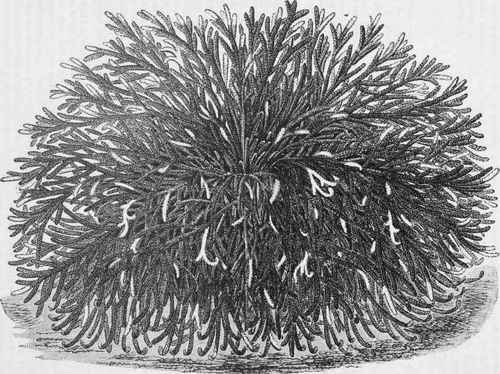
Selaginella involvens variegata.
Aside from such thoughts which this variegated lycopodium suggests, it is a plant of very great beauty. It was brought to our attention by Mr.
Wm. Bull, who furnishes us with the following facts connected with its history :
"A dwarf dense-growing variegated form of greenhouse club-moss, introduced from Japan; some of the branchlets, instead of having the ordinary green color, are creamy white, and these being mixed in freely with the green branchlets, produce an elegant variegation, similar to that which occurs in some of the finely-branched coniferous plants, such as the retinosporas. The plant forms a pretty dwarf tuft, consisted of an overlapping series of flabellate or dichotomously-forked branches, surrounding the central axis. A well-grown specimen is a very pleasing object amongst the dwarfer hardier forms of the club-moss family." This was one of the twelve new plants with which Mr. W. B. gained the First Prize at the Royal Horticultural Society's Exhibitions, in 1880, 1881 and 1882.
Continue to:


My Books

