


Abies Pungens
Description
This section is from the book "The Gardener's Monthly And Horticulturist V28", by Thomas Meehan. See also: Four-Season Harvest: Organic Vegetables from Your Home Garden All Year Long.
Abies Pungens
In the early explorations of the western part of our continent, a pretty spruce was discovered and named Abies Menziesii. Subsequently a species was found in the Rocky Mountains, supposed to be the same. Cultivators found the trees of different values.
The Pacific form would not stand the dry atmosphere of the Atlantic States, and dried out in winter when there were keen cutting winds much below the freezing point. Mr. Douglas discovered that the Rocky Mountain form was able to endure the roughest eastern winter; and though the tree is too short, and too slow to be of much use for forestry purposes in comparison with the western one, it was every way preferable by the cultivator of ornamental trees. Botanists came to look on the tree as somewhat distinct, and it obtained the name of Abies Menziesii Parryana in many quarters, through Dr. C. C. Parry having been the first to introduce the seeds to lovers of pretty trees.
Finally botanists went further, regarded the tree as distinct enough to have a name of its own, and Dr. Eng-elman made it Abies pungens; the pungent or sharp spruce. The leaves are very stiff and sharp-pointed, and the short bases of the leaf-stalks on the older branches make one look sharp enough when handling it. The name is, therefore, appropriate, and yet in some sense unfortunate, as there is already a Pinus pungens, so named from its very prickly large cone, and some botanists see no great difference between a spruce and a pine. Still, Abies pungens is now the name of the Rocky Mountain Blue or White spruce. Some plants are much more gray or blue than others, and Dr. Regel of St. Petersburg is inclined to make still another species out of the very blue form.
Cultivators will, we suppose, continue to call the plant, Rocky Mountain Blue spruce, whatever conclusions botanists may finally conclude its scientific name ought to be.
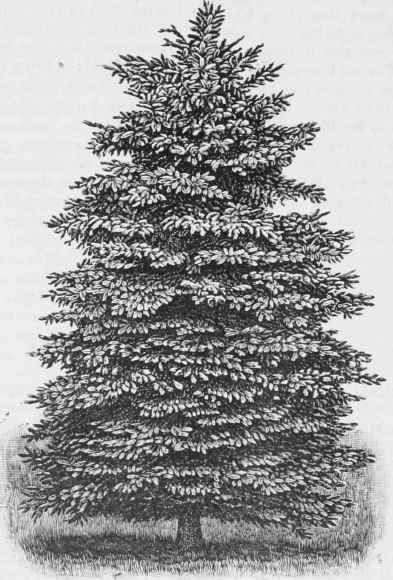
Abies pungens.
We believe the finest specimens along the Atlantic sea-board are near Boston, and the Editor has seen some very superior ones on the grounds of Prof. Sargent, at Brookline. These are all from seed collected by Dr. C. C. Parry in 1860, and by some mistake were labelled for some time A. Engelmanni. There is one in a Germantown garden, presented by Prof. Sargent some years ago, , which is 10 feet high, and beautifully proportionate. The Boston plants are probably better than that. But the best perhaps in cultivation is the one on the grounds of Mr. Asa Whitney, Franklin Grove, Illinois - the tree brought from the Rocky Mountains. The exact height we have not at this writing, but it is near 25 feet high. The accompanying illustration we have made from a photo-tograph sent to us by Mr. Whitney. When it becomes better known, it will be as much sought for in Eastern gardens as the Norway spruce or White pine. We place it among our arboricultural chapters, because it is as yet chiefly known as a forest tree by Colorado travellers.
Probably the finest specimen under cultivation of the Blue spruce of the Rocky Mountains, is on the grounds of A. R. Whitney, at Franklin Grove, Illinois. It is 22 feet high, and 13 feet in the widest spread of branches.
Continue to:


My Books

