


April. Number 328. Flower Garden And Pleasure Ground. Seasonable Hints
Description
This section is from the book "The Gardener's Monthly And Horticulturist V28", by Thomas Meehan. See also: Four-Season Harvest: Organic Vegetables from Your Home Garden All Year Long.
April. Number 328. Flower Garden And Pleasure Ground. Seasonable Hints
Our Southern correspondents seem very sad over the unusual touch of winter they have experienced this season. They have been so full of sympathy with those who are ruled by a boreal hand, that their sorrowings are probably more severe than they might be. To a Northern mind it is the winter that gives the greatest charm to spring. The revival that follows the bleakness of winter, has a pleasure equal to that which the spring itself gives. Only those who have gone through a Northern winter can fully appreciate the joys of spring. It was one of these that sings :
"Now is the high tide of the year,
And whatever of life hath ebbed away
Comes flooding back, with a ripply cheer. Into every bare inlet, and creek, and bay.
Now the heart is so full that a drop over-fills it,
We are happy now because God BO wills it;
No matter how barren the past may have been,
'Tis enough for us now that the leaves are green;
We sit in the warm shade and feel right well
How the sap creeps up and the blossoms swell;
We shut our eyes, but we cannot help knowing
That the sikes are clear and the grass is growing;
The breeze comes whispering in our ear,
That dandelions are blossoming near.
Joy comes, grief dies, we know not how,
Every thing is happy now".
Near all our large towns and cities, the spring of the year finds a large number of new houses being started or in the course of alteration or completion; this brings the gardening question prominently forward. There is generally some chance of getting good advice from intelligent landscape gardeners, but unfortunately few persons know the importance of looking for one, or how to distinguish between a genuine landscape gardener and a mere garden laborer; hence it is that hundreds and often thousands of dollars are uselessly spent in remedying evils that come from the want of this knowledge. Generally all the main work of the landscape gardener is left to the architect, who makes a pretty picture plan of the grounds, but which is found to be in practice enormously expensive or positively ugly. The location of roads or walks, questions of drainage, and the knowledge of how work will look when trees and shrubs grow up, are matters that only competent landscape gardeners thoroughly understand. When undertaking to build or improve, and one is thinking of sending for an architect, it will generally pay handsomely to consult at the same time with some landscape gardener, and let the architect's work and his go along together.
But it is very important to distinguish between a mere grader, road maker, or "practical gardener," and a real landscape gardener.
In suburban landscape gardening there has been a tendency of late years to abolish all line fences and especially those which separate the front yards from the street. This is of course only in cases where the communities have emerged from barbarism far enough to forbid all cattle running loose in the streets. To our mind the essential element of home in its best signification is privacy, and a garden to which one can retire for a while from the busy hum of the outside world, is one of the best features of this domestic ideal. If we wish friends to enjoy our gardens as well as ourselves, we can admit them. Large places often have the rule that at stated times the whole public has the privilege of the grounds. The only ground on which we can see the absence of front yard fences abolished is the public spirit that sacrifices the ideal garden for the public benefit. There can be no doubt that the streets along such lines are much more attractive to the general community than when fenced out of gardens as in the general plan.
But there is not near as much objection to this plan when the houses are on an elevation. Some privacy is then secured. The domestic idea is not wholly abolished; and while the stranger "without the gates," or rather, traveling along the roadside, may point with pride to the residences of certain citizens, the dwellers within may feel that they are homes withal. We have been struck with the force of this argument for the fenceless idea, in elevated places, by a picture in Mr. Frank J. Scott's new edition of Beautiful Home Grounds, which the publisher has kindly permitted us to use. It may be some satisfaction to the author to know that it has been the means of our partial conversion to a system we have before been in no degree favorable to.
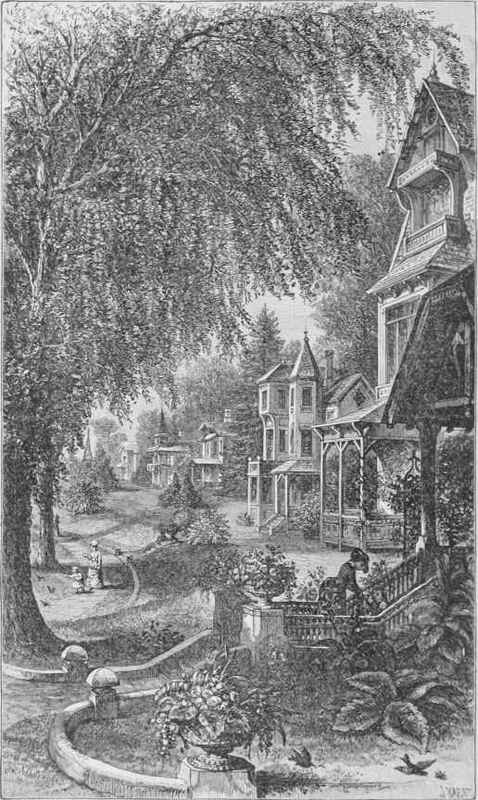
Beautiful Home Grounds.
April is a good planting month. There is not much art in planting trees, though it is often much of a mystery. Not to let the roots dry for an instant between taking up and planting, everybody knows, but everybody don't do it; in fact, everybody deceives himself. We have seen this distinguished individual leave the tops of trees exposed to the sun, with a mat or straw thrown over the roots, and think all was right - or heel in for a day or two, by just throwing a little dirt over the roots. This is a little good : but everybody's fault is, that although this may be ten minutes of good, he expects to get ten hours', or even ten days' value out of it, and thus he suffers more than if he had done nothing; because he forgets that the branches evaporate moisture from the roots in a dry wind, and the juices go from the roots through the branches, very nearly as well as directly to the air from the roots themselves. So with heeling in. The soil is thrown in lightly, or at most just "kicked" down. "It is only temporary," very few of the roots come in contact with the soil. They can draw in no moisture to supply the waste of evaporation, and thus they stay day after day - everybody satisfied because he sees the roots covered; really worse than if they had been exposed.
We have no doubt that more trees are lost from imperfect heeling in than from any other cause whatever. Of course, if the tops be covered as well as the roots, there is less waste of moisture and more chance of success.
We approve of thick planting. Trees grow faster for one another's company, and a place well filled at once, saves many years of time to see them grow. Those not wanted after the place has grown some, can be transplanted to other parts of the ground. Where thick planting is to be adopted, of course care must be taken in locating those permanently to remain. But the trouble usually is that a thickly planted place is rarely thinned. People hate to see a tree cut down. In the public squares of Philadelphia the trees are crowding each other till the whole square looks like a crow's nest. Grass will not grow, first, because of the shade; secondly, because of the poverty of the soil, and thirdly, because of the drought from so many tree roots; and though the city of Philadelphia appropriates $25,000 a year to improve the squares, one each year in succession, it would be as much as the commissioner's place is worth to "cut down a tree." And this is an example of what is often seen. The only remedy is, to educate the public to plant thickly at first; but to thin every few years till they are of judicious width apart.
Continue to:


My Books

