


Communications. Phajus Grandifolius
Description
This section is from the book "The Gardener's Monthly And Horticulturist V28", by Thomas Meehan. See also: Four-Season Harvest: Organic Vegetables from Your Home Garden All Year Long.
Communications. Phajus Grandifolius
How often one meets this old but useful subject eking out an existence under conditions so unsuited to its needs, that it is never able to reward the owner with a single spike of its lovely blossoms. It is classed among the Orchid family, is a native of Hong Kong; and to develop its blossoms in midwinter, should be treated to a temperature of from 55 to 6o°. During summer (being its season of growth) it delights in plenty of heat and moisture. Lumps of fibry loam with the fine shaken out, mixed with an equal proportion of old dry cow manure, with plenty of broken crocks and charcoal, is an excellent compost in which to grow it.
An old neglected plant that had not flowered for years was treated as follows during the past season. As soon as signs of fresh growth had begun in spring, all the old soil was shaken off and the roots washed clean, then potted into compost as above. Water was given very sparingly until the roots from the young growths began to lay hold of the soil. The pot, a 7-inch one, is now a mass of roots, and is watered almost daily with manure water. The growths, three in number, have leaves on two feet long, and each growth is throwing up a strong flower-spike which in a short time will amply repay us with their gay blossoms for any extra care bestowed thereon.
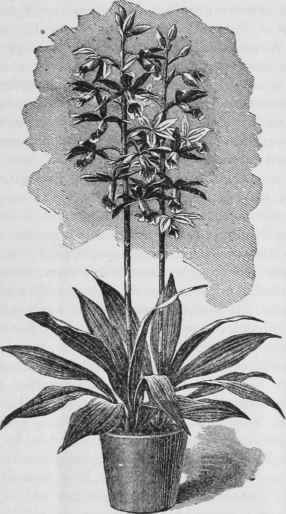
Phajus grandifolius.
Cow manure that has been well dried in the sun during summer, we find excellent for a good many Orchids. Cypripedium insigne we grow in nothing else but sphagnum and cow manure with a few broken crocks among it. I have known plants of this brought to bear two flowers on a spike in such compost, which had never been known to do so before, although considered good plants. A plant of Oncidium incurvum potted in the same last spring has made bulbs larger than the imported ones, and is now throwing up some very fine flower spikes. The Calanthes delight in cow manure, and once used for them always will be. South Virginia, Nov. 20th, 1885.
Continue to:


My Books

