


February. Number 326. Flower Garden And Pleasure Ground. Seasonable Hints
Description
This section is from the book "The Gardener's Monthly And Horticulturist V28", by Thomas Meehan. See also: Four-Season Harvest: Organic Vegetables from Your Home Garden All Year Long.
February. Number 326. Flower Garden And Pleasure Ground. Seasonable Hints
There can be no question about the great beauty to be derived from carpet bedding, when judiciously applied. The proviso is very essential, as misplaced beds, or wholly inappropriate designs are frequently met with. We must re-memberthata design that looks pretty enough when we see all the outlines harmonizing with each other as we look down on it drawn on on a sheet of paper, presents a very different appearance when seen horizontally as a flower bed on the ground. The design is everything in a piece of carpet or mosaic bedding, and often we can only see this design when we look down on the bed from an upper window or some higher elevation. In some grounds sunk gardens have been prepared wholly for the display of these styles of gardening, but there is danger of violence so good taste even here. The Fairmount Park design is that of a sunk garden, but the effect is wholly spoiled by the apparent fact that the garden is sunk expressly to display the ornaments, while true taste in gardening requires that there should be something to ornament in the first place, before ornamentation begins. We can give a certain admiration to treasures exhibited in a jewel case; but jewels are of real value only as they add to the beauty of some pretty person.
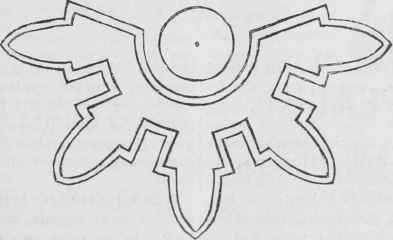
A carpet bed therefore should rarely be made for its own sake; but because it will add a beauty to the location, or increase the interest of a pretty garden. In arranging for carpet beds one must remember that gardening is a combination of nature and art, and in gardening taste requires that they should so run together that one may scarcely tell where one ends or the other begins. Carpet bedding is one of the best possible devices for combining art and nature. It is therefore always most effectual when used in connection with garden architecture. We give with this a very good design for a bed in connection with a garden vase, piece of statuary, or to place pretty close to a building under a bay window or some such projecting ornament. In the latter case a peculiar artificial looking plant, such as an Aloe or Dracaena, would be of course more effective for the circle than a vase or statuette. The narrow margin has to be wholly of one kind of plant, which may be of Echeveria, Centaurea, Leucophyton, Silver Geranium, Gold Geranium, Golden Feverfew, or some other dwarf plant that may be chosen to harmonize whatever may be agreed on.
The fine projecting points may be of one or several kinds, and the ground-work from which they project, and which forms the posterior semi-circle, be all of one kind. Many variations may be afforded by a plan of this kind. For beds formed wholly of succulents of very low growth, or similar plant, and which may be set in the bend of a curving walk, the octo-point star is very popular. It is very easily made, having a square for its working outline, the sides of which are divided into two equal parts. Some put a slender pyramidal plant in the center of such a bed, but to our mind it is prettiest when the whole design is but a gentle rise from the circumference to the center, "ginger-cake" fashion. There are very few flowering plants outside of the Zonale Perlar-gonium class that are well adapted for carpet bedding. Our dependence is mainly on colored leaf varieties. The dwarfer kinds of Petunia, if of one shade of color, as they may be when propagated from cuttings, do pretty well if kept well pinched back to prevent them from running too much to seed.
Carpet beds in general, require frequent pinching in order to get the best results.
Some use for this purpose a pair of scissors or sheep-shears. A plank on blocks at each end, is used as a platform on which to work.
Continue to:


My Books

