


Glazing Without Putty
Description
This section is from the book "The Gardener's Monthly And Horticulturist V28", by Thomas Meehan. See also: Four-Season Harvest: Organic Vegetables from Your Home Garden All Year Long.
Glazing Without Putty
In our May number we made the remark that the quality of putty was of no consequence to greenhouse builders as it is no longer used on the best work. This assertion of ours has evoked a good deal of criticism, and has brought us considerable correspondence, and finding it impossible to answer all of the inquiries in the usual way, we decided to devote an article to the subject. The principal objections to glazing without putty are summed up in a recent work on "Horticultural Buildings," by Mr. Fawkes, of Crompton & Fawkes, London, England, which we quote:
"In glazing without putty the glass usually comes in contact with metal and a certain amount of play is allowed - hot air has abundant opportunities to escape; houses cannot be properly fumigated; crevices for the retention of water by capillary attraction abound; subsequent freezing of this water, and constant breakage are liable; and the crevices also harbor insects; and also the possibility is precluded of placing a board or ladder on the outside of the roof, ' and the cost is greater than with putty glazing.' "
There are several systems of glazing without putty in vogue here, one of which has been extensively advertised, used on some important work, and has had ample time to practically prove its merits or otherwise; another, which, although largely used in England and elsewhere for some years, has only recently been introduced in the United States, and seems to us to be the most perfect system of puttyless glazing yet invented; as the inventor has successfully met and overcome every objection set forth in the above quotation. This method of glazing is shown in the cuts accompanying this article, which give an idea of the construction and ap-pearance. Although the glass comes in contact with the metal, the sash bar is bent to such a shape that it has a great deal of elasticity, while it can be screwed down so tight that there is no play or rattle allowed to the glass, and it can be made absolutely air tight, keeping in the heated air and excluding all dust; and for the same rea sons the house can be fumigated more readily than if glazed with putty; the glass is in much larger panes or lights, than usually used, giving greatly increased light and offering fewer crevices for the retention of water by capillary attraction and consequently offering less opportunities of freezing and breakage from this cause; while the elasticity of the shape of the metal, as before mentioned, allows it to yield to a steady pressure like the power of frost and afterwards return to its original position; there are no crevices for the harboring of insects at the junction or lapping of the glass, while the drip is effectually provided against; the bars are sufficiently strong to bear a ladder on the outside of the roof; indeed, with a few short pieces of boards, a man can walk over any part of the roof without danger.
It is an old and trite maxim that the best is the cheapest, and although the first cost may be more than putty glazing on wooden bars, we must take into consideration the extra cost of large lights, 20x48 inches, over 9x12 inches, as usually used, as part of this cost; then comes the fact that it is there to stay, and to be at the end of twenty years as good as when put on; while we all know the constant source of expense our puttied roofs are are. Our friend, J. N. May, Summit, N. J., is just renewing entirely some houses built only about seven years ago, and we certainly think that the house of the future will be of light iron construction, well built and properly proportioned for expansion and contraction, and glazed with a system of this kind, or better if we can get it.

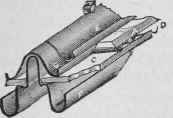
Showing the lap of the Glass.
A Top Light of Glass.
B Condensation Bar.
C Bottom Light.
D Space for Condensation.
E Metal Cap to Top Light.
F Metal Bar with Double Gutters.
G Metal Cap for Lower Light.
So far as we can understand the system introduced by Mr. Jos. Plenty, of 144 Pearl St., New York, it is a great advance on others in existence. We have obtained from him the cuts to illustrate this article, and a reference to his publications will give further information about it.
Aside from these methods of glazing houses where the best and the cheapest methods are desirable, putty is rarely used, even by that class of unfortunate florists who have to do their own work, though it costs more than if they could afford to employ others to give them the best methods on a larger scale. They use a mixture of whitening and oil to bed the glass on the rabets, so that there shall be no space for the collection of moisture, which the slight overlapping would otherwise make. The glass is fastened by glaziers' triangular tin brads, and then the whole upper space, usually finished with putty, is neatly painted. We believe the florist would be considered very far behind the age, who used putty on the outside of even a common hotbed sash.
Continue to:


My Books

