


July. Habits And Natural History
Description
This section is from the book "The Gardener's Monthly And Horticulturist V28", by Thomas Meehan. See also: Four-Season Harvest: Organic Vegetables from Your Home Garden All Year Long.
July. Habits And Natural History
It will be seen from what we stated of this insect in our last annual report (p. 290) that it is a very wide-spread species, occurring from the Pacific to the Atlantic, as far north as Quebec and as far south as Missouri, and that so far as we then knew, it had the normal habit of the group, i. e., was single-brooded, the moths occurring during July and August, after a duration in the pupa state of a month or more. This account of its natural history was based upon observations made in Illinois and Missouri, and we were much interested in ascertaining whether there would be any departure from these habits in New York, especially in reference to the species being single or double brooded, as much of the efficacy of any practical recommendations would depend upon the local facts.
We therefore made every effort to ascertain the facts in the case, and, on the supposition that there might be a second generation of worms, we had Mr. Smith pay two other visits to Goshen, one early in September and one early in October, with a view of making additional observations. Our office notes show that nearly full-grown larvae were received from Goshen on June 18th and 26th, from the onion patches, and that additional larvae were received July 24th and 30th from Trenton, N. J., where they had been feeding on cabbage.
The moths from the first lot of larvae (from Goshen), issued July 25th, 26th and 29th, while those from the second lot (from Trenton) made their appearance August nth, 17th, 18th and 28th. A few pupae, obtained the first week in September, gave out the moths September 8th, 9th and 10th. This corresponds very well with our previous experience, the more northern latitude accounting for the somewhat later appearances in New York than in Illinois and Missouri.
At Goshen all the larvae had apparently transformed by September 2d, the date of Mr. Smith's second examination. This second visit was undertaken in consequence of a report that a second brood of worms had made its appearance and was damaging the neighboring oat fields; but, as it turned out, this report arose from the presence of the army worm (Leucania unipuncta) in the oats. The onions had ripened and were largely gathered, many fields having been replanted in corn, oats or turnips in consequence of the damage done to the onions by the worms. A more careful search through the onion fields showed no traces of the eggs, larvae or moths, but by digging he found a few pupae inclosed in earthen cells some 4 inches below the surface of the ground. They were very scarce and he found no empty shells to indicate that they had been more abundant. The probabilities are that a vast majority of the larvae fell a prey to Tachina flies, the eggs of which were noticed on a very large proportion of the larvae in June.
A further examination at the beginning of October failed to reveal any traces either of eggs, larvae, pupae or moths in the vicinity of the ravaged onion fields, save a few empty pupae shells in the same locality where the pupae were found in September. There had been at this time a frost severe enough to form ice, and it is safe to presume that the season for the development of the species had at that time ceased.
From the experience of the year it is evident to our mind that there was no second generation, and that, therefore, the previous observations in the West have been confirmed on this point. Both Mr. Smith's examination and our own office notes are entirely negative in throwing further light on the method of hibernation, and, as we know from our former experience that the fullgrown larvae are found early enough in the season to injure the buds of fruit trees - the best evidence that they have hibernated - and as the larval hibernation is by far the most common among the cut-worms, we are still of the opinion that the species so hibernates as a rule, even in New York State.
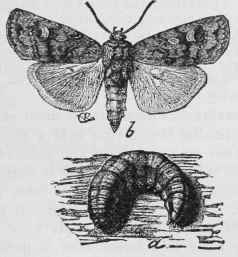
This does not, however, preclude the hibernation of some of the later-developed moths, and the fact that neither moths, eggs nor young larvae were found in October must, we think, be explained on two grounds, (1) either limited and insufficient search, or (2) their occurrence in adjacent localities or on other plants. There are no fixed rules which can always be depended on in the life habits of these insects, as exceptional occurrences, such as this wide spread injury to onions around Goshen, are very probably due to exceptional conditions. Thus, while the normal habit may be to hibernate in the larva state, exceptional climatic conditions may bring about an exceptional hibernation of the moths. This would seem to have been the case in this instance, more especially as the land in which they occurred has for the last few years been planted to onions season after season. Unless the onion fields were allowed to get quite weedy in the fall (which is not the case) the larvae could not well develop so as to hibernate in any quantities in the field, and the methods of culture, as well as the condition of the larvae in June and their absence in October, all point to spring hatching. The worms had not been seen before, and the moths most probably concentrated on the fields in the spring.
We have, however, no records of captures of the moths later than September 10th.
We regret not to be able to give a description of the eggs or of the place of oviposition, but it is not at all improbable that they are laid on many different plants or even upon shrubs which the larvae, on hatching, abandon.
In our last report the subject of remedies for cut-worms was considered in a general way as applying to all of the species there treated of, and in this particular case, the circumstances being more or less peculiar, our general recommendations must be somewhat modified to suit. We have said nothing about the peculiar conditions connected with this Goshen outbreak, nor have we mentioned the remedies tried by the onion-growers, as these are described both by Mr.Smith and Mr. Bennett in their reports, which follow.
We believe that the crop can be grown successfully even in a marked cut-worm season by adopting the following measures:
As a preventive we would treat the land early in spring with a mixture of lime and ashes (preferably wood ashes). This mixture should be spread lightly over the land, after plowing, and harrowed in.
If, after the seed is sown and the plants have begun to come up, the worms still appear and threaten damage, we would employ the poisoned ball system described on pages 299 and 300 of our last annual report. This, in brief, consists in placing along the rows, at a distance of 15 or 20 feet apart, small bunches of fresh cut grass or other green plant (cabbage leaves where available), which have been previously sprinkled with dilute Paris green or London purple. By this means nearly all of the worms can be destroyed with a minimum of trouble.
If, as is very improbable, the worms should still appear in great numbers, by migration from surrounding fields, we would sprinkle the fields at night, while the worms are at work, with a dilute emulsion of kerosene. Mr. Smith shows that pure kerosene has been tried at Goshen with the effect of killing the worms and simply blackening, but not killing, the onion tips. We are not satisfied, however, that the free use of pure kerosene would not seriously injure the plants, and we recommend instead an emulsion as being safer and much cheaper, while just as effective in killing the worms. The kerosene is emulsified with soap or milk in order that it may be readily diluted with water. For the proper preparation and application of the emulsion a good force-pump is needed, but beyond this no apparatus is necessary. The best formula for this preparation is that given on page 331 of our last annual report. There is little doubt but that by a thorough spraying of the fields at night with this mixture the worms can be destroyed by wholesale. It should be used most thoroughly at the points in the field where the worms are first noticed to work, and from which they spread to surrounding portions.
The first appearance should be watched for with the greatest care, and should be followed by the most energetic efforts to destroy them.
[The above is an abstract of a paper in the recent report of the Entomologist of the Department of Agriculture, and refers to an insect doing an immense amount of injury to the onion growers in the Eastern States. - Ed. G. M].
Continue to:


My Books

