


September. Number 333. Flower Garden And Pleasure Ground. Seasonable Hints
Description
This section is from the book "The Gardener's Monthly And Horticulturist V28", by Thomas Meehan. See also: Four-Season Harvest: Organic Vegetables from Your Home Garden All Year Long.
September. Number 333. Flower Garden And Pleasure Ground. Seasonable Hints
Whoever has travelled in the South at midsummer must have been struck with the great beauty of the old neglected fence-rows, covered with Trumpet Creeper, and all ablaze with their fiery red blossoms, - varied only by a few leaves here and there and the moving shadows of the flowers, as they trembled under the flutter of the honey-sucking humming-bird, which in innumerable hosts made their meals among the blossoms. We get some idea of this scene of beauty from the cultivated plant in northern gardens, where it is often allowed to run over walls, trees, and other places, making a fair show. It is, indeed, one of the most esteemed of hardy vines in the northern part of United States; as, aside from the beauty of its flowers, it is one of the few plants that will adhere to walls without nailing or trellising of any kind. But few know how beautiful the plant is when trained as a weeper, or, if desirable, over a wire, to form an arbor. In this case there is nothing that we know of that can compete with it in beauty. To do this it is only necessary to plant a stake that will last several years alongside the plant when set out. When the plant gets towards the top, head it off, and cut away the side shoots.
By the time the post is rotten, the stem of the vine is self-supporting. We annex (p. 258) an illustration copied from the Gartner Zeitung - the plant being more popular for this purpose in Germany than here, in its native land. In Japan there are some closely allied forms, having larger flowers, but less brilliant than those of our country. Wistarias and other strong-growing vines can be made into "trees" or weepers in the same way.
With the month of September we begin to lay out plans for the improvement of our grounds. Herbaceous plants, like varieties of fruits, usually delight in being renewed from seed occasionally. Save at this season those that may be particularly desirable and sow early next spring. If sown now some may bloom next year.
We may make up our minds now what trees to thin out when the winter comes. In almost every place trees are too thick, except where clumps of trees are desired for landscape effect. Along streets twenty feet is the space usually given. This is well enough for the first ten years, but after that forty is enough. A tree which spreads its branches is always more graceful than a mass of branches drawn up. And a tree which spreads affords no temptation to have its head cut off. Such trees are bad subjects for the tree butchers that infest the environs of all large towns.
In transplanting this fall do it as early as possible, that the earth may settle well about the roots before winter sets in. All successful planting really depends on how soon the mutilated roots can draw in moisture to supply the waste of evaporation; hence if a tree has been badly dug and has few roots or the roots appear dry or weak, lessen the demand on them for moisture by cutting away some of the branches. In this cutting take the weak branches, and not the strong and most vital ones, as are often stupidly sacrificed, and above all see that the earth is tightly packed about the roots; for, unless the earth is in actual contact with each rootlet the work is not perfectly done. If there is a rootlet which even by a hair's breadth does not touch the earth, that rootlet might as well not be there. It is a very good plan to lift the tree up and down a little before the earth is hammered" in about the roots, so as to allow the earth to close in around the roots as much as possible.
Hardy bulbs should be transplanted when necessary in the fall, and the earlier in the fall the better. They will do pretty well up to frost. All this applies to Dutch bulbs as well as others. Bulbs like to be rather deep, and to have the soil rather rich and rather damp. It is the low reclaimed mud of Holland which helps their bulbs quite as much as the skill of the Dutch gardeners.
We have said a good deal about ornamental hedges in past numbers; but not, perhaps, as much as the subject deserves. Not only do they make the very best kind of boundary fences, and form in themselves beautiful objects, but they have a great use in small places in breaking off long and uninteresting scenery, and, by dividing perhaps one grand view into innumerable parts, make a small place seem very large indeed.
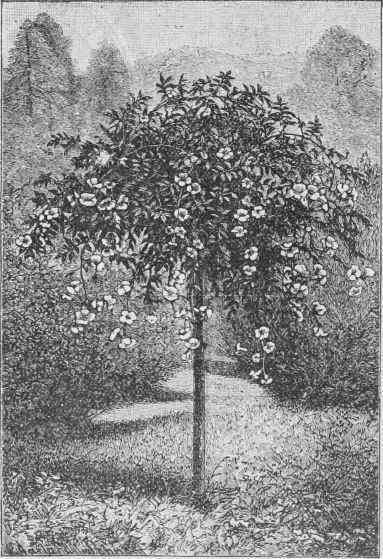
Trumpet Creeper as a Weeding Tree.
Of evergreen hedges the most readily obtained are Norway Spruce and Scotch Pine, Hemlock, Spruce, and Chinese and American Arbor Vitae, - but where dwarf dividing lines are desirable the golden Retinospora and dwarf forms of Arbor Vitae make pretty objects. Of deciduous hedge-plants almost any of the thick growing shrubbery make pretty hedges.
It is not necessary to wait till all the leaves are off before planting. Cut away whatever may not be mature; no matter if those of no experience regard it as barbarous to do so. No one regrets it who once tries the plan. Gardeners take the leaves off of cuttings they make, and a transplanted tree is in much the position that a cutting is.
Continue to:


My Books

