


The Amaryllis. Continued
Description
This section is from the book "The Gardener's Monthly And Horticulturist V28", by Thomas Meehan. See also: Four-Season Harvest: Organic Vegetables from Your Home Garden All Year Long.
The Amaryllis. Continued
I have the following hybrids in my collection :
1. Hippeastrum (Amaryllis) Johnsonii, Herb
Across between Hippeastrum vittatum and Hippeastrum Reginae. Raised by Johnson in Lancashire, England, 1810, and a year later by Dean Herbert. This is the common Amaryllis of our Southern gardens. It is one of the best for the beginner, as it is easy to flower, very fine and slightly fragrant.
2. Hippeastrum (Amaryllis) Cleopatra
Dark red, with a clear white stripe. An exceedingly beautiful hybrid.
3. Amaryllis Oriflamme
White, banded with salmon. Fine form.
4. Amaryllis Prince Of Orange
Fine orange red; very showy.
5. Amaryllis Perle
Sulphur white, with large salmon stripes. The last two and Amaryllis Olga I received from Nanz & Neuner (Louisville, Ky). They have also many unnamed fine hybrids of Amaryllis Johnsonii.
6. Amaryllis Defiance
An evergreen hybrid and one. of the finest in cultivation. Has large carmine-red flowers with bars of white running through the centre of each petal, and the whole flower lined and penciled with white; large, very fine formed flowers.
7. Amaryllis Artemise
Pure white with large vermilion stripes.
8. Amaryllis Baffin
Very dark red.
9. Amaryllis Clovis
Fine transparent red with large white stripes.
10. Amaryllis Phoebe
Pure white, striped and striated with carmine-rose. The last five with Amaryllis ori-flamme can be obtained of Hallock, Son & Thorpe (East Hinsdale, N. Y.).
11. Amaryllis Rejulgens And (12) Amaryllis Atrosanguinea
Both very dark shining red, of fine form and texture. Cheap and very easy to grow. I obtained mine from Mr. Saul, Washington, D. C.
13. Amaryllis Graveana
Beautiful red; a very fine hybrid. Advertised by Mr. Peter Henderson, New York. Besides these I have fine unnamed collections from Germany, Holland and France, many of which have not yet flowered. I mentioned only those which can be furnished by some of our leading florists.
1. Amaryllis Dr. Masters
Flowers 6 inches in diameter, perfect in shape, the segments recurving so as to give a bold appearance. A deep crimson scarlet, colored to the base, with maroon shaded blotches. This is said to be the finest Amaryllis in cultivation, being unique both in color and form.
2. Amaryllis Exquisite
A fine, well-defined flower, 7 inches in diameter, of exquisite shape, carmine scarlet, the larger or guard segments have distinct white stripes, whilst the others are beautifully flaked with the same.
3. Amaryllis Fascination
One of the light colored type; flowers about 5 inches in diameter, segments.
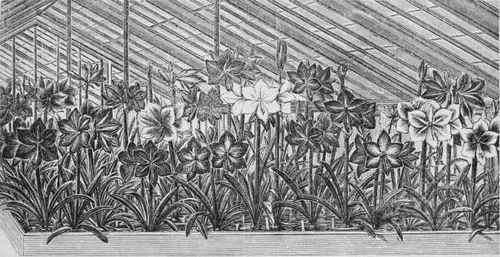
Amaryllis House at Veitch's Nursery, Chelsea.
Now I step to the finest hybrids in existence, but I do not know how to find words to describe their bright colors and fine forms according to their merit. The varieties of which I now speak were raised by Mr. B. S. Williams, Upper Hallo-way, London. These hybrids have become so popular in England that Mr. Williams found it necessary to erect a special Amaryllis house, in which thousands are grown at present. His magnificent hybrids are the results of many years careful labor and careful selection. If compared with the finest continental collections, which sell from $40 to $240 a dozen; they are cheap and are far more beautiful. Indeed, I have seen no Amaryllises that can be compared with these English kinds, either in coloring or form. Every lover of this class of plants should have at least a few of the following sorts: perfectly round, regularly flaked and barred with reddish crimson.
4. Amaryllis Harry Williams
A noble flower, about 8 inches in diameter, the segments about 4 inches broad and well shaped; the color is reddish purple, the centre of which is slightly flaked and penciled with white. A distinct type.
5. Amaryllis Loveliness
Flowers about 7 inches in diameter, of rosy crimson color, white stripe in the center of each petal and also white margin.
6. Amaryllis Mrs. Garfield
A cross between Hippeastrum recticulatum and Amaryllis Defiance. Evergreen, leaves robust, with a white stripe. The flower-scape, which is thrown up about 2 feet, produces four to five flowers 6 inches in diameter, of good form and substance, and of a pleasing rosy-pink color, netted and veined with a darker tint of the same color; there is a white stripe in the centre of each petal, producing a most charming contrast to the numerous crimson scarlet varieties now so common in collections.
7. Amaryllis Mrs. William Lee
In growth this hybrid much resembles Amaryllis Mrs. Garfield, but the flowers are much larger and the color altogether richer. Similar is a new hybrid, Amaryllis Compte de Germiny, the finest of this group.
8. Mrs. B. T. Williams
Pure white and of fine form.
9. Amaryllis Masterpiece
Flowers 6 to 7 inches across; sepals and petals broad, nicely recurved; color rich crimson-scarlet, with a violet shade extending entirely to the base and not showing a particle of an eye.
10. Amaryllis Prince Teck
Flowers large, ground color being of a soft creamy yellow, which runs down the centre of each petal; the edges of the petals are deep crimson and beautifully marked with netted lines of the same color.
11. Amaryllis Princess Dagmar
Petals of great breadth, margined and veined with carmine-scarlet, and having a light base; one of the finest forms and most brilliant in color.
12. Amaryllis Triumphant
Flowers 6 inches across, carmine-scarlet, segments perfectly round, with a light base flaked with white.
13. Amaryllis Unique
Extra fine form, petals broad, color deep bright scarlet, centre of the petals shaded with black, white markings in the throat.
14. Amaryllis Williamsii
Petals of great breadth and substance, ground color carmine-scarlet and having a broad white band down the centre of each petal. Mr. Williams has raised many more beautiful hybrids, but these, I think, are the most beautiful. There is another celebrated Amaryllis grower in England, but I have not yet had an op portunity to procure some of his varieties As soon as I know these hybrids from personal observation, I will give an account of them in the Gardeners' Monthly. And now, dear reader, I beg your pardon for this long paper.
Friestatt, Mo. [The readers will rather thank than want to "pardon" the author of this excellent paper. Correspondents are continually asking the Editor for the names of their varieties, showing the want of just these descriptive notes as well as the widespread interest being taken in this beautiful tribe. In the Old World particular attention is being given to their culture, and some nurserymen are making them special branches. We give with this a view of the Amaryllis House, as it is called, at Veitch's Nursery, Chelsea. - Ed. G. M].
Continue to:


My Books

