


The Culture Of Tree Mignonette
Description
This section is from the book "The Gardener's Monthly And Horticulturist V28", by Thomas Meehan. See also: Four-Season Harvest: Organic Vegetables from Your Home Garden All Year Long.
The Culture Of Tree Mignonette
It is very easy of culture, and by exercising a little judgment in the sowing of a few seeds at different seasons of the year, and care in cutting away the dead flowers as they appear, it may be had in bloom in the conservatory every month in the year. It may be formed into various shapes, according to the taste of the cultivator. Some prefer growing it in the shape of a cone, with one plant in the centre of a pot, the stem of the plant tied to a neat stake, the side shoots regularly stopped and trained, and the flowers pinched off as they appear, till the plant has attained its desired height and size. Others choose to have five or six plants in a 32 or 24-sized pot, and when these are neatly trained they are very useful, and never fail to be admired in the winter season and onwards for several months.
I have grown a few very pretty standard Mignonette plants, and as they are generally much admired, I will briefly detail their cultivation.
About the end of March, seed was sown in several small 48-sized pots, placing three or four seeds in each. The compost used chiefly consisted of decayed turf pulled to pieces with the hand, but not riddled, intermixed with horse droppings passed through a fine sieve; sand being added to keep the compost open. In a mixture of this description, Mignonette seems to thrive well and bloom freely. When the seeds were sown the pots were placed in a cold pit, and and as soon as the seedlings were large enough to distinguish which were the largest and strongest plants, the best were selected to remain, and the others thinned out, and thrown away. As soon as the pots were filled with roots, but before the plants became pot-bound, these were moved into 6 inch pots, and in this size single plants will form good heads of bloom, if occasionally assisted with weak manure waterings.
Some prefer larger-sized pots in order to grow extra strong plants, but I rather like 6-inch pots, for they can then be placed in a small vase, and used occasionally for dinner-table decoration.
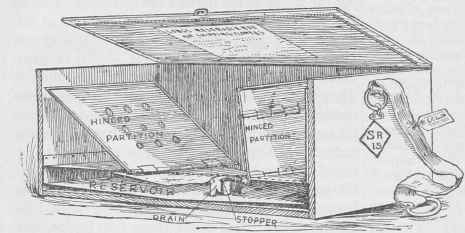
Reservoir Shipping Box showing one side removed and zinc bottom partly broken to show interior arrangement.
When the plants were several inches high, a neat stake was placed to each to keep them erect. The side shoots as they appeared, were carefully pinched off near to the main stem, carefully leaving one or two leaves at the base of each successive shoot to strengthen the plant and keep the roots active. This I consider rather important, as, if the plant were denuded of all its leaves as the stem progressed, its health would become impaired, and prematura decay would set in. Much the same course was pursued until the plants had attained the desired height.
As the plants became established, they were removed from the cold pit, and placed on a bed of coal ashes out of doors. They were stopped at heights varying from 16 inches to 2 feet, and as the flower buds appeared these were regularly pinched out, to force the plants to form a neat bushy head, until about the end of September when each was furnished with a profusion of shoots, which were allowed to expand their bloom. By pinching-off the decayed blooms, the plants will continue to flower throughout the winter months; but, to secure the perfection of fragrance, they require both sun and air, and, consequently, when convenient, should be placed in proximity to the openings by which the air is admitted into the houses. - C. R., in Gardeners Record.
Continue to:


My Books

