


The Pennsylvania Horticultural Society
Description
This section is from the book "The Gardener's Monthly And Horticulturist V28", by Thomas Meehan. See also: Four-Season Harvest: Organic Vegetables from Your Home Garden All Year Long.
The Pennsylvania Horticultural Society
A rose exhibition was held on the 8th of June, and an excellent display made. The first premium was awarded to H. A. Dreer, and the bronze medal to Mr. Hughes, gardener to George W. Childs, Esq.
We received the following note from Mr. J. E. Mitchell, President of this venerable body, on the 21st of December, wholly too late to be of any service to him in securing a "Christmas present" from any of our readers, or even a present for the New Year. All communications should be sent previous to the 5th of each month, if notice in the succeeding issue be desired.
"The Pennsylvania Horticultural Society, founded in 1827, is the oldest in this country. It was founded by some of the best men of that day : Dr. Chapman, Geo. Pepper, John Vaughn, Jos. Hopkinson, Nicholas Biddle, Chas Chauncey, Horace Binney, M. Carey, D. Landreth, D. Mau-pay, Jno. McAran, and other public spirited citizens. It has had for Presidents, Horace Binney, Jos. R. Ingersoll, Geo.Vaux, Caleb Cope, Robt. Patterson, M. W. Baldwin, and other distinguished citizens. W. L. Schaffer, recently deceased, occupied the chair for 17 years. In 1844 this Society had a membership of 800 of our best citizens, and after an uninterrupted and useful life of over 40 years, its membership is now about the same number, although our population has increased about four-fold during that period; had the taste for the beautiful in nature increased in the same ratio among our people, this Society should now have about 3,000 members; this would enable its officers to increase its attractions, add to its library, publish its transactions, and increase the moderate money premiums now offered, and thereby stimulate our florists and others to increased exertions in improving the products of the garden and orchard.
As this Society now depends on receipts from membership to carry it on, no more valuable Christmas present could be made, than $3.00 which constitutes a membership for a year".
At the spring exhibition of this Society, Tuesday, March 16th, to Friday, 19th, 1886, the General Union of Holland for the Promotion of the Cultivation of Bulbs, under the patronage of the King of the Netherlands, offers the following prizes to be competed for by nurserymen, seedsmen and florists only: Hyacinths, 50 named bulbs, in 50 pots, forced in pots, first prize, Gold Medal; second prize, Silver Gilt Medal; third prize, Silver Medal.
In addition, the Pennsylvania Society has decided to offer premiums to be competed for by ladies only : 12 Hyacinths, grown in glasses, first premium, Gold Medal; second premium, Silver Gilt Medal; third premium, Silver Medal. 6 Hyacinths, grown in glasses, first premium, Silver Medal; second premium, Bronze Medal.
Very much interest is being taken in these premiums, and from all we hear it is likely to be an unusually interesting occasion.
In addition to these special attractions, there will be premiums open to all contributors. A very full list of premiums, for all sorts of pretty things, has been issued and may be had of A. W. Harrison, Secretary, Horticultural Hall, Broad Street, Philadelphia.
This body has gotten up a very handsome schedule of its proposed work for the coming year, copies of which may be had from the secretary, A. W. Harrison, Horticultural Hall, Philadelphia. A new idea is a calendar on which the date of monthly meeting nights is stamped in red.
The spring exhibition of the Pennsylvania Horticultural Society was held on the 18th of March, and resulted in a very pretty show. The gardeners and amateurs seem to have been frightened out of competition with the successful exhibitors of last year, so they had the field in a measure to themselves. The chief interest settled on the Holland Premiums for Hyacinths and other bulbs. The Gold Medal for fifty Hyacinths was secured by U.
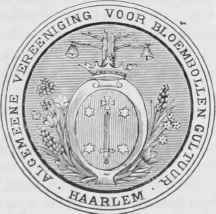
The Holland Bulb Medal.
Fergusson's Sons. In the absence of any definite rules as to what constitutes a first class Hyacinth, the work of a judge is very unsatisfactory. What is a " best " Hyacinth to one, is inferior to another. It is to the credit of a large number of the exhibitors of this society, that they are lenient to the judges, and are generally satisfied with the awards made. In these cases there was a certain something unnamable that made all feel the judges had made fair decisions in spite of the difficulties of their position. The Gold Medal set were of nearly uniform height, had the heads from about few under 6 inches long, and the strong stems well up above the foliage. The leaves were comparatively short and broad, from 4 to 12 inches long. The plants grown in 4-inch pots. The Holland Silver Medal, to Christian Eisele. These had an average of shorter heads, the range being about 4 inches, and the flowers were not thrown as far above the leaves as the others.
First premium for twenty-five kinds of Hyacinth was awarded to Mr. A. Warne. These were in 8-inch pots. These were remarkable for the size of the individual flowers; the spikes were elongated, and not in the dense masses noted in the plants of other growers. The second best, to Mr. Ch. Eisele, had the bulbs split, so that there would be two or three small spikes as well as the one larger. This we suppose would be looked on as a defect in a first-class Hyacinth.
First premium for the best six plants of the old white Lily, Lilium candidum, was awarded to Mr. W. K. Harris. They were in 6 inch pots, about 4 feet high and with seven flowers. The first for Lilium longiflorum Harrisii, to Griffin Bros. These were about 3 feet high, with about six flowers on each, with the very large flowers having a tube of about 7 inches long. The best single specimen of this variety, to J. W. Colflesh, had more flowers, but more slender stems.
First six Tulips, to A. Warne, gardener to Mr. Clarence H. Clark. Six kinds, six plants in a 6-inch pot. The leaves were large and healthy, flower stems 8 to 10 inches, and the large 4-inch flowers uniform in all the kinds. Mr. W. K. Harris had second premium; these were six plants, six of a kind, in 8-inch pots. These were not so regular in growth, and size of flowers or strength of stem, but the varieties were very distinct, which was a good point. Duchess de Parma, Joseph Von Undell, Rosamond, Cottage Maid and Grand Duke were particularly distinct sorts.
Continue to:


My Books

