


Zinnias
Description
This section is from the book "The Gardener's Monthly And Horticulturist V28", by Thomas Meehan. See also: Four-Season Harvest: Organic Vegetables from Your Home Garden All Year Long.
Zinnias
Gottingen, in Hanover, seems to have seen the first cultivated Zinnia over one hundred years ago. The seeds came from Peru. The Professor of Botany in the newly-established University (John Godfrey Zinn) figured it. He did not think it was a new genus, but, in those days when they had but one name and a host of adjectives, described it as "Rudbeckia folius oppositis." Linnaeus saw the distinction between the two, and gave the name to its first describer. Thus we have Zinnia. That species is now Zinnia pauciflora, and grows wild over the whole of South America from Peru, extending north to Arizona. Other botanists had considered it a Bidens - a common plant in our northern swamps. These references show its relationship. A strong point of difference is the permanence of the ray-florets. In other allied plants they wither and fall away - as in the sun-flower or aster, for instance, - here they remain, though losing the lustre of the earlier stage. From this fact they have obtained the common name of " youth and old age" - young flowers and faded flowers remaining together to the end. The common name, however, has not become common, probably be" cause the botanical name is so easy - Zinnia is more commonly its name than its expressive common one.
The gay kinds of our gardens come from Zinnia elegans, a Mexican species, introduced to England in 1796, but its great improvement by florists has only been of recent date. The first step was to produce them of a variety of colors - that is to say, variety in the strap-shaped ray petals, for the tubular petals of the cone-like disk, with the anthers, were always retained of a bright yellow. These tubular flowers were perfect - that is to say, they had stamens and pistils, and each little floret produced one seed. The ray florets had pistils only, but with pollen, brought by the wind or insects, these florets were generally fertile also.
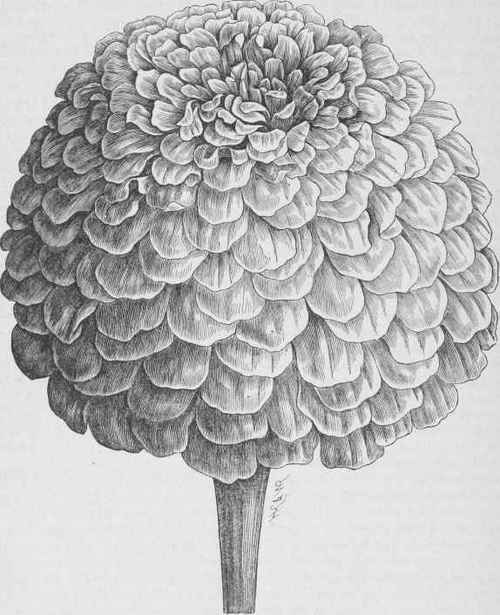
Zinnia elegans robusta grandiflora plenissima.
Of late years florists have produced double zin nias; but the doubling is not as in the rose or carnation, by the change of stamens to petals, but by the little yellow florets of the disk splitting their tubes on one side, opening them, and becoming flat like the ray florets. The most remarkable fact to the close observer is, that, while changing their tubular character to the flat condition, they change both sex and color. They have no longer stamens, but are purely pistillate, as in the ray florets, and are of the same tint. There are, however, usually a few disk florets retaining the tubular and pollen-bearing character, or if the flower is wholly pistillate, pollen is received from other single or semi-double heads - for these almost wholly pistillate heads are usually productive of a full supply of seeds, and the florists who have undertaken to improve them find little difficulty in getting the characters they desire sufficiently hereditary for commercial purposes.
Among those who have undertaken to lead in the improvement of the Zinnia, the firm of Lorenz, of Erfurt - who gave us Gaillardia Lorenziana - stands prominent. They have now a strain which has flowers of an enormous size, and wholly double, which we give as an illustration. They have carried us back to ante Linnaen time, when the plant had but one name and a string of adjectives. They call it "Zinnia elegans robusta grandiflora plenissima,' but we suspect our busy gardeners will shorten its cognomen to "Lorenz' Zinnias," or Lorenz' strain.
Continue to:


My Books

