


New Or Rare Plants. Philodendron Andreanum
Description
This section is from the book "The Gardener's Monthly And Horticulturist V29", by Thomas Meehan. See also: Four-Season Harvest: Organic Vegetables from Your Home Garden All Year Long.
New Or Rare Plants. Philodendron Andreanum
The Aroids now so generally under culture are everywhere appreciated for their singular foliage, which often has the added interest of striking tints and markings. A lovely bronzy tinted one has recently been brought out by Messrs. Veitch & Son, which we desire to introduce to our readers, and have obtained from these gentlemen the following account of it:
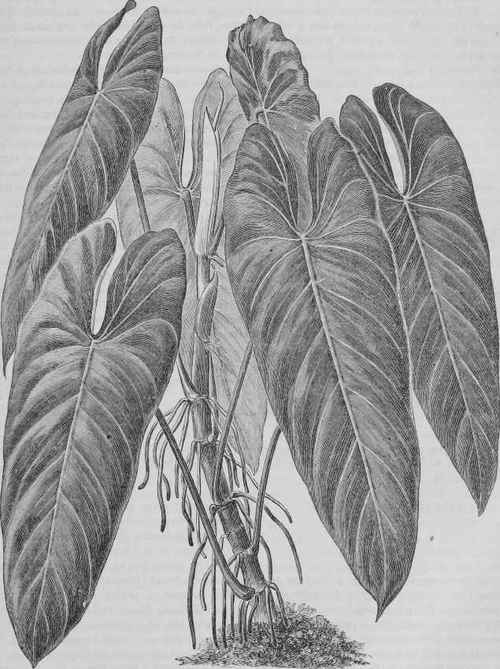
Philodendron Andreanum.
"A striking Aroid, first discovered by M. Andre, of Paris, and subsequently introduced by us direct from New Granada; it is by far the finest species of Philodendron for decorative purposes ever brought under cultivation. Its stately foliage when fully developed may be compared, for size and effectiveness, with that of Anthurium Veitchii and A. Warocqueanum.
"The cordiform-lanceolate leaves are deflected vertically from a robust erect footstalk, and attain a length of four to five feet. When first expanded on the young plant they are of a decided scarlet tinge shaded with brown, when a little older they become a bronzy red-brown before finally changing to the normal bright velvety green of the mature leaves. Through all these changes the colors are relieved and enhanced by the white midrib and nerves that branch from it.
"We received the award of a First Class Certificate for this plant at the Royal Horticultural Society's Show at Liverpool, in June, 1886, under the name of Philodendron grandidens, where it formed one of the principal attractions of the group of plants exhibited by us. We also received a Certificate of Merit for it from the Royal Botanic Society two years previous under the same name".
We may add that the name "Philodendron" signifies "a lover of trees," over which some species in tropical countries love to climb.
Continue to:


My Books

