


Perle Des Jardins - The Gold Strawberry
Description
This section is from the book "The Gardener's Monthly And Horticulturist V29", by Thomas Meehan. See also: Four-Season Harvest: Organic Vegetables from Your Home Garden All Year Long.
Perle Des Jardins - The Gold Strawberry
Perle Des Jardins
Mr. James Taplin of May-wood, N. J., reports that this beautiful yellow rose was a partial failure in that section of the country last winter.
Cold Water For Flowers
"Mary E. F." inquires " whether it has been settled if watering plants with cold water is an injury to them?" We think it has been entirely settled. It does not hurt plants in the least, as a general thing, so far as any permanent injury to the plant is concerned; but if we want a plant to hurry up its flowering, warm water is an aid. Cold water somewhat retards rapid growth. That is all there is now in the question.
A Fine American Aloe
Mr. Henry Higley.of Cedar Rapids, Iowa, sends us a photograph of what is probably the finest specimen in cultivation of the great American Aloe. It is 7 ft. 6 inches from box to extreme top. The box is 2 1/2 ft., making the plant 10 feet high. It has a spread of a little over 12 feet. The exact age of the plant is not known, but is supposed to be about 30 years.
Fruit In Massachusetts
A note from Worcester, Mass., August 2nd, says that peaches never looked better at the same date. There will not be many apples, it being an off year - but there are more than usual, considering this circumstance.
The Fig In California
This promises to be the most permanently profitable of all California fruits. The orange has hitherto been given the highest position.
The Sharpless Strawberry
There have been some complaints this year that the Sharpless did not get red right up to its point, as it usually does - but the plants continue remarkably healthy. So far as we have heard no spot has yet appeared on its leaves and it will probably not be necessary to introduce " the most wonderful berry in the world " to replace it for some time yet.
Approved Strawberries For Ohio
Mr. M. Crawford a noted fruit grower of Cuyahoga Falls, reports for the past season that Jessie, Itasca, Summitt, Ohio (pistillate), Bubach, Jewell, Ontario (too near Sharpless), Belmont, Covel (better than Crescent), Lida and Henderson as varieties among the newer ones, have good points recommending them to cultivators.
The Gold Strawberry
Of the same parentage as Jewell, and about the same size. Its flavor is said to be very superior, and the size equal to Jewell.
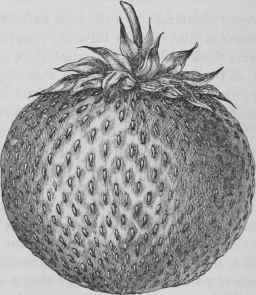
The Gold Strawberry.
The annexed illustration shows how the form differs from its sister berry, the Jewell. The large number of small seeds together with the globular form, will be good characters for identification.
Continue to:


My Books

