


A Beautiful Dwelling
Description
This section is from "The Horticulturist, And Journal Of Rural Art And Rural Taste", by P. Barry, A. J. Downing, J. Jay Smith, Peter B. Mead, F. W. Woodward, Henry T. Williams. Also available from Amazon: Horticulturist and Journal of Rural Art and Rural Taste.
A Beautiful Dwelling
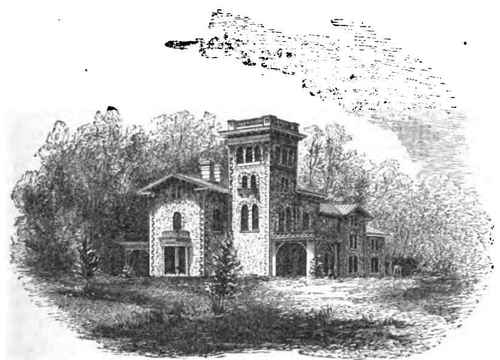
The annexed representation of a house was taken by an amateur daguer-reotypist at our request, to exhibit a tasteful structure of stone, well adapted to the wants of a family requiring "all the comforts." It has been erected lately in the vicinity of one of our principal cities, and is esteemed in the neighborhood a perfect house. The inside divisions will easily present themselves, and may be modified to suit different tastes. The porte coehere is admirably situated; you drive through it to the stables, concealed by hedges.
A pleasing writer in Fraser's Magazine for December last, who, by the way, devotes several pages to Mr. Vaux's work on cottages, pro and con, discusses the impossibility of our being happy anywhere, and declares, " I do not hesitate to say that the scenery amid which a man lives, and the house in which he lives, have a vast deal to do in making him what he is. Life in itself is a neutral thing, colorless and tasteless; it takes its color and its flavor from the scenes amid which we lead it. It is like water, which external influences may make the dirtiest or cleanest, the bitterest or sweetest, of all things. Life, character, feeling, are things greatly dependent on external influences; only stolid people are not affected by the scenes in which they live." We all remember the little child in Wordsworth's poem expressing a decided preference for one place in the country over another, which appeared to have greater attractions; and who, when pressed for his reasons, did, after much reflection, fix upon a single fact as the cause of his preference: -
"At Kilve there was no weathercock; And that's the reason why".
He adds, "I do not think I have ever seen happier people, or people who appeared more thoroughly enviable, than those who have been building a pretty residence in the country." If, then, this is a source of happiness, and external influences are of great import, it is well to select a good example, and build your mansion with taste.
Continue to:


My Books

