


Jaminette Pear
Description
This section is from "The Horticulturist, And Journal Of Rural Art And Rural Taste", by P. Barry, A. J. Downing, J. Jay Smith, Peter B. Mead, F. W. Woodward, Henry T. Williams. Also available from Amazon: Horticulturist and Journal of Rural Art and Rural Taste.
Jaminette Pear
Fruit - Size, medium; form, globular, obovate, obtuse, pyriform; skin, rough; color, light greenish, yellow ground, dotted and marbled with russet, especially around the stem insertion and calyx basin; stem, medium length and size, inserted with a very slight depression; calyx, small, with short segments; basin, shallow, regular; flesh, yellowish white, rather coarse and gritty until fully ripe, when it becomes melting, juicy, sweet, vinous; core, small; seeds, globular, obovate, pyriform; season, December to February.
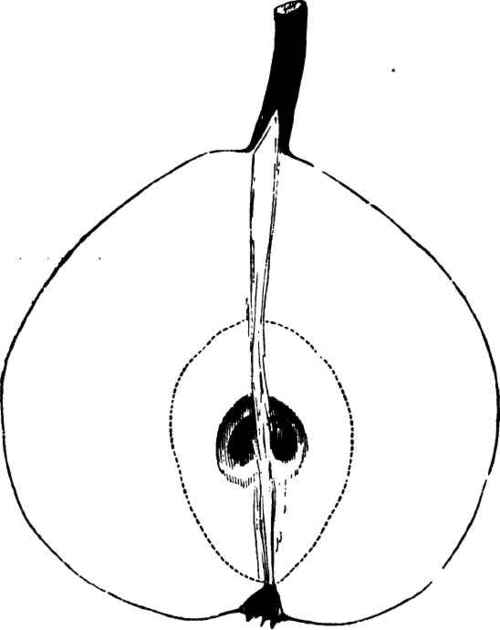
Fig. 46, - Jaminette Pear.
The Jaminette is an old pear, which, we think, has been too much overlooked and neglected, or thrown aside to give place to new and untried sorts. The tree is a strong, healthy grower, forming a beautiful upright spreading tree, producing freely, and when under good cultivation, the fruit of even and regular size. As a winter pear for amateur growing, that is, for use in our own family, few, if any, winter pears surpass it. As a market sort, however, it is not sufficiently showy to meet sales at a high price.
Jaminette Pear #1
Glad to see this old pear brought out again. I have known it many years grown on the pear root, and giving yearly crops of fruit that are put away in the fruit-cellar and kept until midwinter as well as apples, and then brought out and ripened up, proving rich, juicy, and capital to eat. It should always be left to hang on the tree as late as it is possible without danger of freezing,
Continue to:


My Books

