


Pinus Hartwegi - Hartweg's Pine
Description
This section is from "The Horticulturist, And Journal Of Rural Art And Rural Taste", by P. Barry, A. J. Downing, J. Jay Smith, Peter B. Mead, F. W. Woodward, Henry T. Williams. Also available from Amazon: Horticulturist and Journal of Rural Art and Rural Taste.
Pinus Hartwegi - Hartweg's Pine
This species is a native of Mexico, where Hartweg discovered it on Mount Campanario, growing at an elevation of 9000 feet, and ranging immediately above Picea religiosa. It forms a tree of moderate size, with leaves six inches and upwards in length, of a pale green, and covered with a glaucous bloom: Although this Pine belongs to the five-leaved section of Pinus, it is often found with four only in a bundle. The cones are four to five inches long, and pendulous. Many of the species in the group to which Hartweg's Pine belongs are remarkable for the length of their leaves; and this, there being five in a sheath, gives them a peculiar and striking appearance, and as such they are much prized by collectors. Unfortunately the winter of 1853-4, and the following one, proved fatal to many of the handsomest kinds, and they may be pronounced too tender for the English climate. Of this section, we lost from our collection leiophylla, Wincesteriana, Gordoniama, filifolia, Russelliana, Devoniana, Grenvilleae, and even palustris (australis); while Hartwegi, Montezuma, and apulcensis of the long-leaved species survived.
And we find pretty nearly the same results happened in other Pinetums. This greatly enhances the value of those which have turned out to be hardy; among them Hartwegi - which is now the finest of the long-leaved species, capable of enduring our winters, excepting, perhaps P. microphylla. No collection of Conifers can be called complete except it contains our present subject, which, even in a young state, has something grand and striking in its appearance. Although the soil should be naturally dry or well drained for growing it, it prefers a good, rich loam, rather heavy than otherwise.
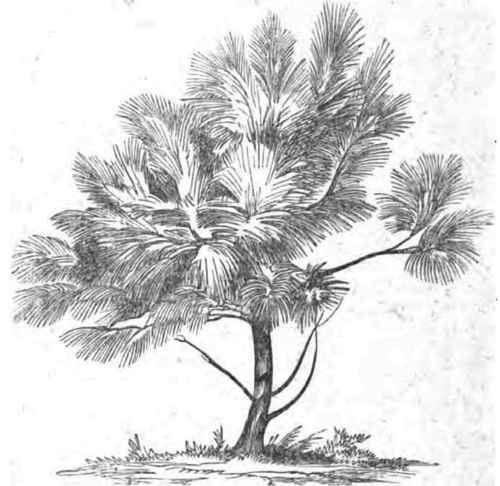
Pinus HartwegL.
In composition, this section should be grouped together, as they do not harmonize well with the short-leaved kinds. Planted in this way, and in appropriate situations, they will form a striking mass, very distinct from anything else.
Our engraving was taken from a fine specimen in the Pinetum at Nuneham Park, near Oxford. - London florirt.
[This pine was destroyed last winter at Wodenethe, but would be a very valuable acquisition at the South. - Ed.] .
Continue to:


My Books

